

 Australia
  Brazil
  Canada
  Chile
Chile  China
China  Columbia
  Denmark
  Egypt
Egypt  France
  India
India  Indonesia
  Ireland
  Italy
Italy  Malaysia
  New Zealand
  Norway
  Panama
  Peru
Peru  Poland
  Portugal
  Saudi Arabia
  Singapore
  South Korea
  Spain
Spain  Sweden
  Taiwan
  Thailand
  Türkiye
  United States
  Vietnam


Bridging the gap to net zero
Empowering local transport authorities with a data-driven toolkit for quantifiable carbon reduction.

Achieving net zero by 2050 is a formidable challenge for local authorities. With the Department for Transport (DfT) guidance on Quantifiable Carbon Reduction (QCR) now mandatory for the development of Local Transport Plans decarbonisation needs to be at the heart of every strategy. But how can local authorities identify which interventions will truly cut carbon?
The Decarbonisation Policy Playbook, developed by SYSTRA in partnership with Atkins for Midlands Connect, provides a solution. Our toolkit eliminates guesswork, enabling policy officers to appraise the carbon reduction impacts of proposed interventions with confidence

The Playbook helps local transport authorities identify the right schemes – from road space reallocation to sustainable transport improvements – to include in their net zero strategies. Built on a robust, DfT-aligned evidence base, the Playbook ensures your carbon estimates are data-driven, defensible, and aligned with national targets.
Related services

Strategic toolkit for local authorities
The Playbook has been designed for ease of use to help local transport authorities identify which schemes and policies will achieve the best outcomes. Core features include:
- The user interface Test single interventions or complex packages with maximum flexibility. Whether you are modelling walking and cycling networks, bus priority measures, or workplace parking levies, the interface allows for rapid scenario testing.
- The calculation engine Our engine does the hard graft, crunching numbers to apply the impact of chosen interventions to vehicle kilometres. It captures the trade-off between reduced car use and the emission profiles of remaining traffic.
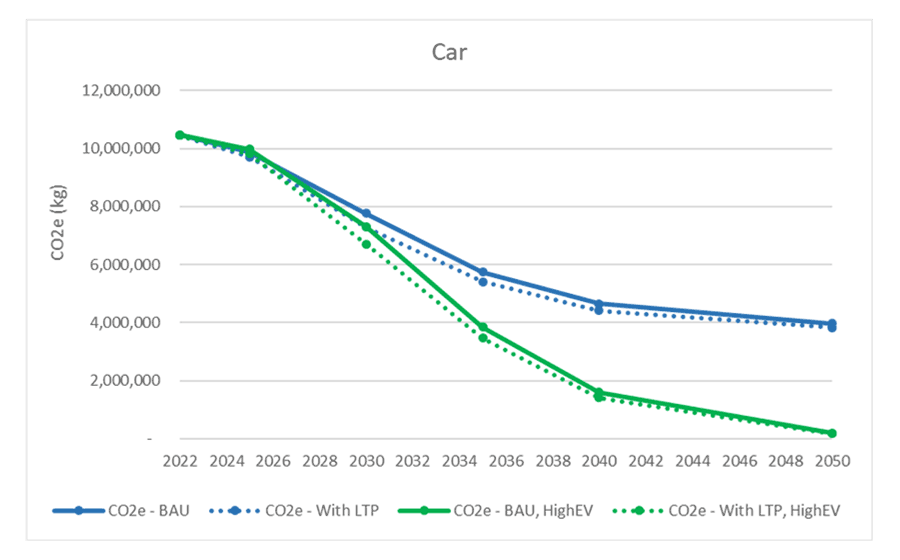
- The emissions module This module uses revised future fleet profile proportions to calculate total carbon emissions for each future year. We generate clear charts and tables to summarise predicted reductions.
Calibrated for geography: The seven place types
The Playbook is uniquely calibrated to predict how geography influences predicted impacts of different interventions across seven distinct place types. By using Office for National Statistics (ONS) boundary data to allocate traffic emissions—from urban centres with high active travel potential to remote rural areas where car dependency is higher—the Playbook fits the jigsaw pieces together. This provides an accurate estimate of your overall emissions reduction potential, tailored to your specific landscape.
Built on a robust evidence base
The Playbook is underpinned by an unparalleled foundation of data integrity to ensure your LTP4 remains defensible and DfT-aligned. Our team conducted a Rapid Evidence Assessment of 122 peer-reviewed sources and analysed the travel patterns of 1.5 million individual trips from the English National Travel Survey.
This rigorous framework manages expectations by illustrating the precise balance between ‘carrot’ measures and the ‘sticks’ required to meet legal mandates. By providing this standardised evidence base, the tool enables you to track progress accurately following the latest QCR guidance, ensuring that every strategic decision is supported by proven behavioural research.
Support with preparing for LTP4
With the Decarbonisation Policy Playbook, you can be more confident with planning. If you need support with any aspect of your LTP4 preparation or the Quantified Carbon Reduction process, our team is ready to help.
How do I comply with DfT Quantifiable Carbon Reduction (QCR) guidance?
To meet mandatory DfT requirements for LTP4, you must provide data-driven evidence of carbon savings. The Decarbonisation Policy Playbook by SYSTRA provides this defensible framework. It uses a robust calculation engine to ensure your local transport strategies align with national net zero targets and audit standards.
How do I calculate carbon savings for local transport schemes?
You can use the Decarbonisation Policy Playbook to automate complex calculations. The toolkit appraises interventions like active travel or bus priority measures against seven distinct place types. It crunches data from 1.5 million trips to provide clear charts and tables showing predicted vehicle kilometre and emission reductions.
How can I test different transport scenarios for net zero planning?
The Playbook user interface allows for rapid scenario testing. You can model single interventions or complex packages to see their immediate impact on emissions. This enables policy officers to identify which combination of schemes will most effectively bridge the gap to net zero for their specific authority.
What is the best way to model transport decarbonisation in rural areas?
Effective modelling must account for geography. The Decarbonisation Policy Playbook uses ONS boundary data to calibrate impacts across different landscapes. This ensures rural authorities can accurately predict emissions where car dependency is higher, rather than relying on urban-centric data that might not reflect local reality.
Future-proof your transport plan
Turn complex policy into quantifiable results. Use our calculation engine to model transport interventions with confidence.
SYSTRA simplifies the quantified carbon reduction process, helping you prioritise the most effective schemes to reach net zero targets across your unique geography.

We’d love to help with your next project

David CONNOLLY
Director of Low Carbon Mobility

Malcom CALVERT
Director of Digital Products and Services

request a PLAYBOOK demo
Insights

- Expert Insights
David CONNOLLY
A Decarbonisation Policy Playbook to support LTP4 development
Read more
The Road to Zero Carbon
Read more sur The Road to Zero Carbonour Services
- services
Transport Data Analysis & Visualisation
Read more sur Transport Data Analysis & Visualisation
- services
Local Transport Modelling
Read more sur Local Transport Modelling
- services
Digital Solutions and Software Development
Read more sur Digital Solutions and Software Development
- services
Local Transport Modelling
Read more sur Local Transport Modelling
- services