

 Australia
 Brazil
 Canada
 Chile
 China
 Columbia
 Denmark
 Egypt
 France
 India
 Indonesia
 Ireland
 Italy
 Malaysia
 New Zealand
 Norway
 Panama
 Peru
 Poland
 Portugal
 Saudi Arabia
 Singapore
 South Korea
 Spain
 Sweden
 Taiwan
 Thailand
 Türkiye
 United Kingdom
 United States
 Vietnam


Putting people at the heart of transport systems
At SYSTRA, we integrate human factors throughout every stage of the transport system lifecycle. Our specialists ensure that equipment, interfaces and environments are designed around the people who use them – drivers, operations and maintenance staff, and passengers – to improve safety, user experience and operational efficiency.
Our team combines specialist Human Factors & Ergonomics expertise with a strong understanding of systems engineering. Drawing on multidisciplinary expertise and experience from rail and other sectors, we help organisations develop mobility solutions that are intuitive, effective and compliant with applicable requirements.
INTEGRATING HUMAN FACTORS THROUGHOUT THE PROJECT LIFECYCLE
From the earliest project stages through to decommissioning, our specialists work alongside engineers, designers and the end users of transport infrastructure. They draw on established methods, industry best practice and real-world experience to ensure that technologies, environments and processes are suited to how people actually work, interact with systems and travel.
Understanding real-world use from the outset
From the earliest stages of a project, we consider the needs of drivers, operations and maintenance staff, passengers and other relevant users. Depending on the project, this may include analysing task organisation, procedures, interfaces, workplace ergonomics and the information provided to users.
Improving workplace and interface ergonomics
We analyse workplaces, interfaces, tasks and environments to improve usability, comfort and efficiency.
Designing with end users
We work directly with end users to understand their needs, behaviours and the challenges they face. Their feedback informs design decisions and helps us develop solutions that are better suited to real-world use.
Reducing human error and risk
We analyse situations that could lead to human error or difficulties in use, enabling risks to be identified as early as possible and appropriate measures to be incorporated into the design from the outset.
These key areas of expertise illustrate how our holistic approach to human factors contributes to successful project outcomes.
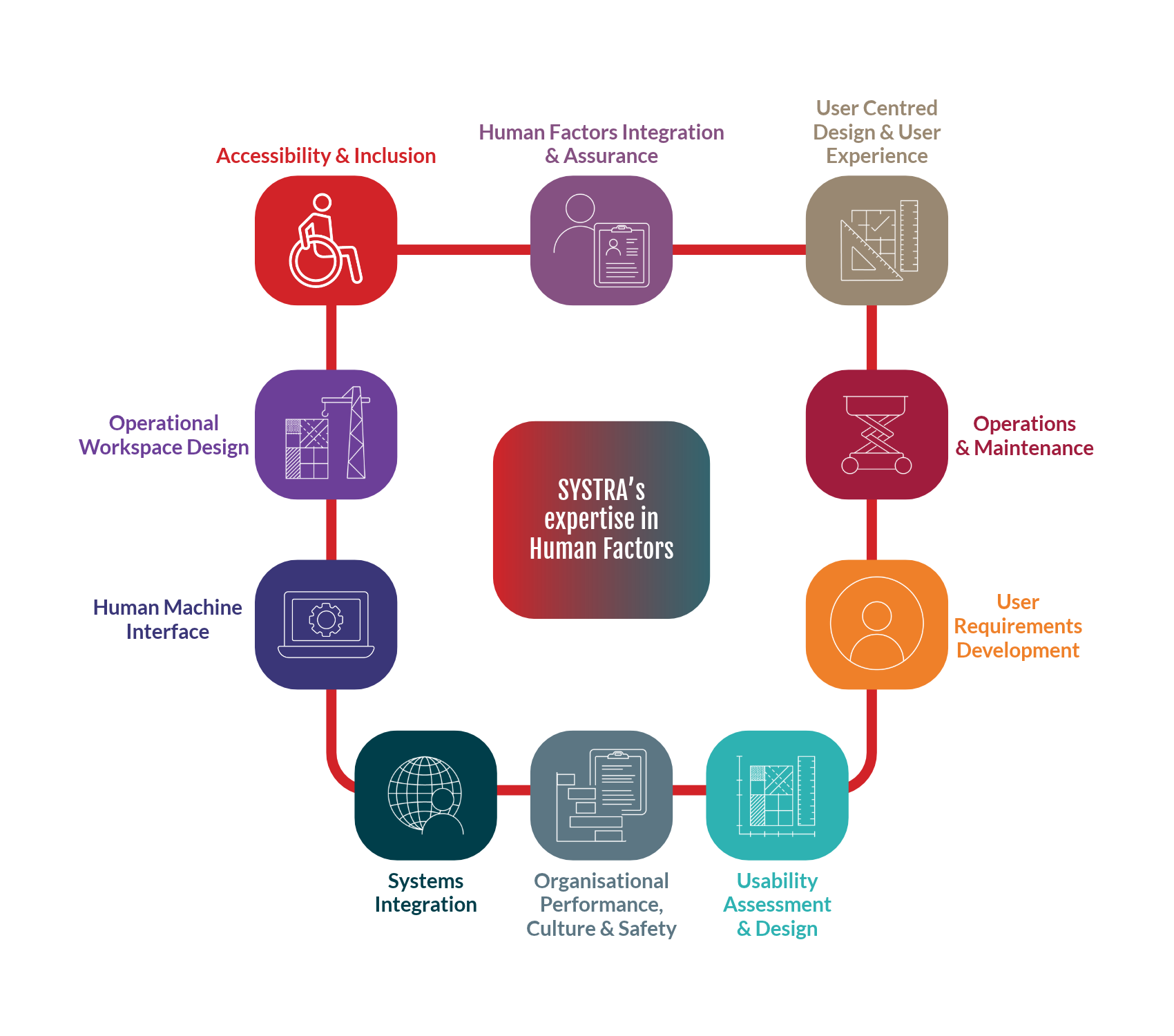
OUR APPROACH
Our specialists combine observation of real-world use, engagement with users, simulation and ergonomics analysis to understand how a system will actually be used. Depending on the project, they may assess the design of a driving or control workstation, test how well users understand an interface, or analyse the tasks carried out by operations and maintenance teams.
These assessments allow design options to be tested early and potential issues to be identified before systems enter service. Throughout the project, our experts work closely with engineers, designers and future users to ensure that human factors are embedded in the design process.
Delivering tangible benefits for projects and operations
- Safer systems: identifying situations that could lead to errors, misunderstanding or inappropriate use at an early stage helps to better manage risk.
- More efficient operations: workplaces, interfaces and procedures designed around real-world use make tasks easier for operational teams and contribute to improved operational performance.
- Better-informed design decisions earlier: testing how systems will be used and involving users from the outset helps avoid costly rework, delays and late-stage modifications.
- A better experience for all users: systems that are easier to understand and use improve the experience of both transport professionals and passengers.





FURTHER LINKS
- Human Factors and Ergonomics in Transport on SYSTRA’s UK & Ireland website
- Human Factors on SYSTRA’s Australia & New Zealand website
- Read our Expert Insight on Managing Operational Change for Electrification Projects (SYSTRA UK & Ireland)
- Read our Expert Insight on Human Factors in ETCS design (SYSTRA Australia & New Zealand)