Australia
  Brazil
  Canada
  Chile
Chile  China
China  Columbia
  Denmark
  Egypt
Egypt  France
  India
India  Indonesia
  Ireland
  Italy
Italy  Malaysia
  New Zealand
  Norway
  Panama
  Peru
Peru  Poland
  Portugal
  Saudi Arabia
  Singapore
  South Korea
  Spain
Spain  Sweden
  Taiwan
  Thailand
  Türkiye
  United Kingdom
  United States
  Vietnam


Ahmedabad Railway Station, Gujarat’s largest rail hub, is undergoing a major redevelopment to become an integrated multimodal gateway linking Indian Railways, Ahmedabad Metro and the Mumbai–Ahmedabad High-Speed Rail corridor. In 2024, the Rail Land Development Authority (RLDA) appointed the SYSTRA–Mace joint venture to provide project management consultancy for the programme, which is being delivered while the station remains operational.
The nearly 40-hectare programme is designed to improve capacity and the passenger experience while supporting the long-term development of the surrounding station area.
Managing a complex brownfield programme
Ahmedabad Station handles around 160 trains and 120,000 passengers each day. Delivering the redevelopment within this live environment requires careful phasing, rigorous safety and quality management, and close coordination between railway operations, construction activities and the numerous projects converging on the station site.
SYSTRA and Mace are providing project management services across design review, works supervision, quality control, safety coordination, interface management, testing and commissioning. Digital e-PMC tools support programme monitoring, reporting and decision-making throughout delivery.
Integrating mobility, architecture and heritage
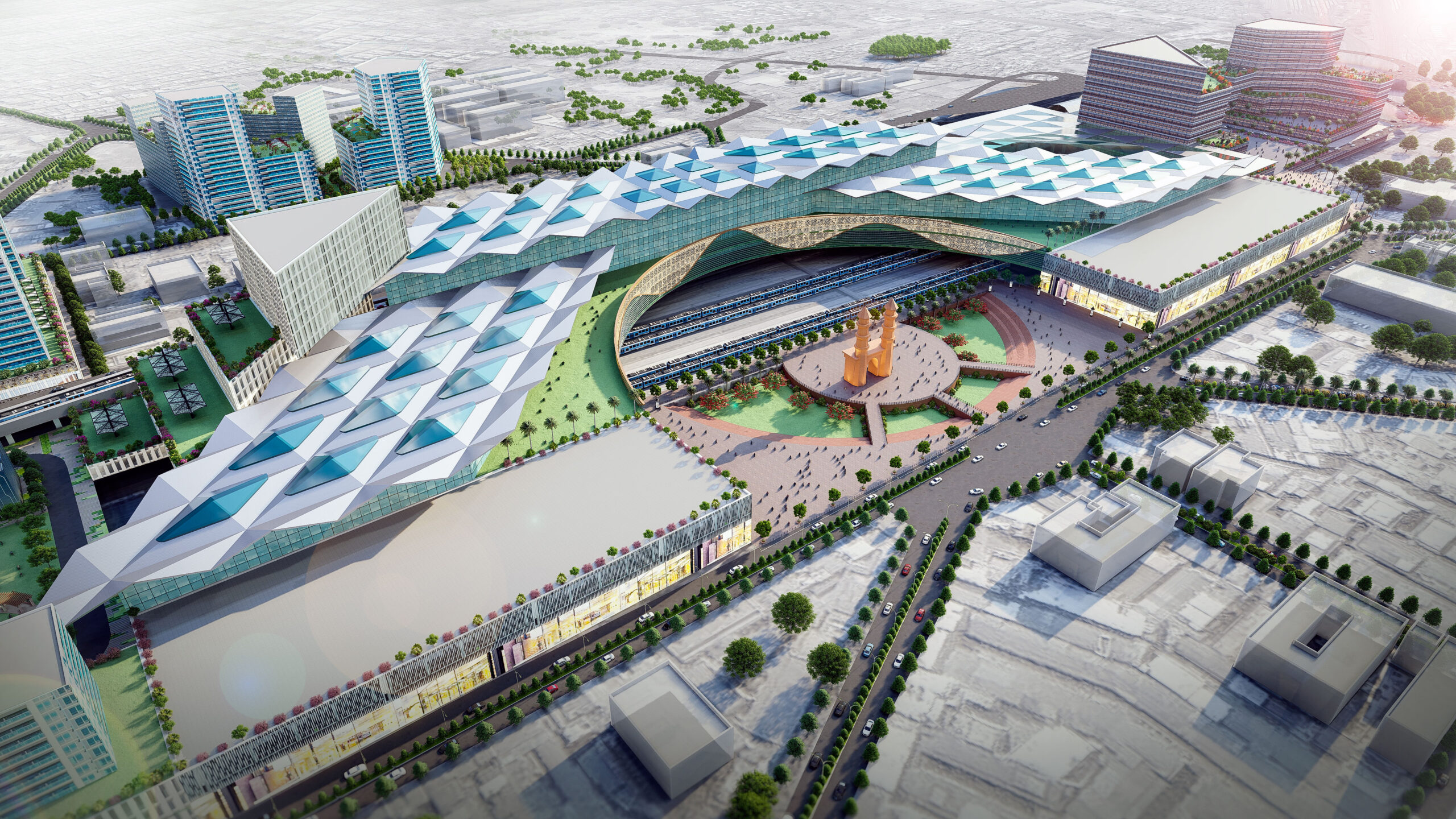
The redevelopment will connect the conventional rail station with Kalupur Metro station and the adjacent Ahmedabad high-speed rail station, creating more direct transfers between local, national and future high-speed services. Elevated roads and pedestrian links will reorganise access from both sides of the city and improve connections with buses, taxis and private vehicles.

The programme includes a ground-plus-16-storey multimodal hub development, expanded concourses, retail and passenger facilities, and a dedicated parcel-handling complex. These elements are intended to improve circulation, increase operational capacity and create a more coherent gateway to the city.
The architectural concept draws on the Modhera Sun Temple and includes an open amphitheatre inspired by the Adalaj Stepwell. The scheme has also been developed around protected heritage structures near the station, including the Brick Minar and Jhulta Minar, integrating them visually into the wider redevelopment.