

 Australia
  Brazil
  Canada
  Chile
Chile  China
China  Columbia
  Denmark
  Egypt
Egypt  France
  India
India  Indonesia
  Ireland
  Italy
Italy  Malaysia
  New Zealand
  Norway
  Panama
  Peru
Peru  Poland
  Portugal
  Saudi Arabia
  Singapore
  South Korea
  Spain
Spain  Sweden
  Taiwan
  Thailand
  Türkiye
  United Kingdom
  United States
  Vietnam


Transport infrastructure is already facing more frequent and more intense extreme weather events. Infrastructure resilience must be planned from the earliest study phases, through design choices, funding models, construction methods and operating conditions. In the face of these challenges, engineering plays a key role: it translates climate projections into concrete actions to reduce vulnerabilities and prioritise adaptation efforts.
A very real change
The 1.5°C warming threshold, the most ambitious benchmark of the Paris Agreement, is no longer a distant prospect. According to the latest update of the global climate indicators, published in June 2026 in Earth System Science Data, warming caused by human activities could reach this level around 2030. This outlook reinforces the need to adapt infrastructure today to future climate conditions.
In several regions where SYSTRA is delivering major projects, infrastructure is already facing climate hazards with very real consequences. For example:
- In the United Arab Emirates, the equivalent of nearly two years of rainfall fell in less than 24 hours in 2024, causing massive flooding, including in some Dubai metro stations, disrupting operations for several months. The damage has since been estimated at nearly $3 billion overall.
- In Canada, wildfires can reach an exceptional scale: 18 million hectares burned in 2023, nearly twice the size of Portugal, followed by 5 million in 2024 and 9 million in 2025.
These phenomena are becoming more frequent and more severe, creating major risks for infrastructure. The synthesis work carried out by IPCC experts (6th Assessment Report, 2022) provides a statistical overview of these vulnerabilities:
- 7.5% of the world’s roads and railways are already exposed to a 100-year flood risk, representing average annual potential damage of around US$15 billion (Koks et al., 2019).
- Climate-related damage to European transport infrastructure could increase twentyfold and reach US$10 billion per year by 2080 (Forzieri et al., 2018).
- Infrastructure assets exposed to climate risks could depreciate by up to US$4.2 trillion by 2100 under a +2°C scenario (Economist Intelligence Unit, 2015).
Infrastructure managers, owners, and operators are therefore facing an unprecedented challenge. How can long-term climate conditions be anticipated? How can infrastructure resilience be ensured with increasingly constrained budgets? How should adaptation efforts be prioritised, and based on what criteria? These are critical questions to which our experts provide very concrete insights.
Insight no. 1: Digital solutions make complex data easier to understand, enabling us to better anticipate climate risks and vulnerabilities (Marc Boudier)
Integrating infrastructure adaptation from the design phase has become essential. This does not mean revolutionising design methods, but adapting them to take different climate change scenarios into account.
These scenarios depend on assumptions about future greenhouse gas emissions globally and over time. Historical data alone is no longer sufficient for designing infrastructure and anticipating future conditions that diverge from past observed trends. They must be cross-referenced with climate projections based on IPCC-validated scenarios, as well as with the sensitivity of assets to climate hazards. This anticipation at the design stage is key to achieving the defined performance and safety objectives during operations.
This approach requires bringing together a wide range of expertise: climate science, design, data science, risk management, infrastructure, systems, operations, and maintenance. It makes it possible to integrate resilience as a design parameter and support informed decision-making.
SYSTRA has developed its own digital solutions to visualise complex data and make them usable for project teams and partners: Climateplus visualises future climate conditions, while ClimateViz maps infrastructure vulnerability, helping guide adaptation from the design stage onward.
These solutions are being used on the Alto project, Canada’s first high-speed rail project. This future line, unprecedented in scale for the country, will extend over 1,000 km and connect Quebec City to Toronto in under five hours, compared with more than eight hours today, notably via Montreal and Ottawa.
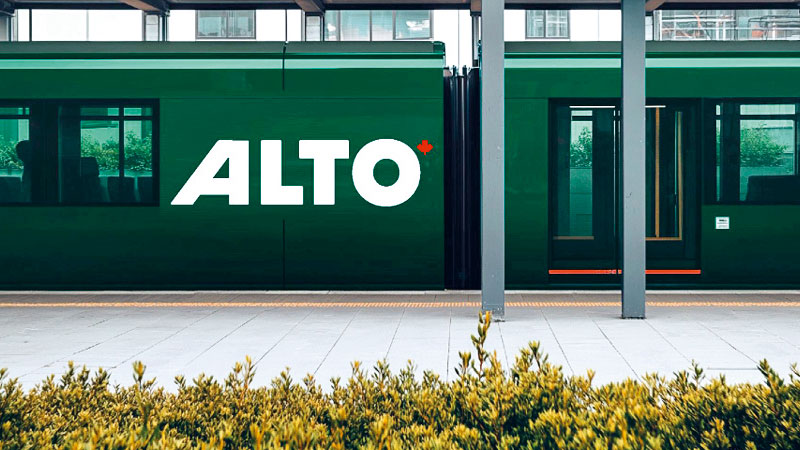
The future corridor could cross areas potentially exposed to different climatic conditions, ranging from harsh Canadian winters to summer heatwaves, as well as spring and autumn rainfall.
To integrate these issues from the design stage, Climateplus uses 19 climate indicators, based in this use case on Canada-specific reference data from climatedata.ca, covering in particular temperatures, droughts, liquid and solid precipitation, frost days and freeze-thaw cycles. These data make it possible to anticipate changes in climatic conditions over various time horizons, and to develop climate change factors in order to adjust the project’s design thresholds and criteria.
Climate specialists and design teams work closely together to translate these projections into technical choices. ClimateViz will complement this approach as part of the adaptation plan by combining climate projections with infrastructure asset maps in order to identify potential areas of vulnerability and prioritise adaptation measures.
Insight no. 2: Responses must be tailored to both the immediate situation and the long term (Abdelkarim El Archi)
Adapting infrastructure rarely involves a single solution. The approach generally consists of proposing several options, then comparing, objectively assessing and ranking them. Faced with the same climate risk, several solutions can be considered at different geographic and/or timescales: protecting only the rail or road infrastructure concerned, extending protection to a wider area, managing emergency situations first, and then proposing shorter- or longer-term solutions.
Engineering provides decisive value here by translating adaptation to a climate hazard into concrete solutions, assessing their effects, costs, benefits, implementation constraints, and the stakeholders likely to finance them. By comparing these solutions according to criteria defined with decision-makers, we enable them to make informed choices and select the solution that best meets their needs.
The case of Sharjah in the United Arab Emirates illustrates this shift toward a multi-level response: first emergency management, then a more lasting adaptation strategy. In April 2024, the UAE experienced record rainfall. The equivalent of one and a half to two years of average rainfall fell in a single day. In Sharjah, flooding affected particularly sensitive areas, notably around an official building and near an area characterised by concave geomorphology crossed by a highway and a railway line.
In this area, a wadi, a temporary watercourse typical of arid regions, had been heavily constrained by urbanisation and certain agricultural developments that restricted the natural flow of water. During the event, the breach of a natural levee, or dune, caused the wadi to overflow its bed. Some of the flow was then diverted toward low-lying points, leading to water levels rising by 3.5 to 4 m, with levels locally reaching nearly one metre above the railway line.
SYSTRA was called in by Etihad Rail to produce a rapid assessment of the situation and help define the immediate actions needed to restore service on the railway line and the highway. This initial response involved field investigations, satellite data analysis, hydraulic calculations, and a reconstruction of the site’s hydraulic behaviour. It made it possible to understand the origin of the flooding, strengthen natural protections, and reduce the risk of an immediate recurrence.

SYSTRA then studied several adaptation scenarios. The comparison included technical, economic, and territorial criteria: cost, level of protection provided, protected area, impact on future developments, and possible distribution of financing among stakeholders benefiting from the solution. A 2D hydraulic model, based on updated extreme rainfall data, was used to estimate the areas protected by each scenario.
The selected solution combines temporary consolidation of the wadi by means of an embankment, the longer-term creation of a 9-km channel, and the addition of twenty culverts under the two highways crossing the watercourse bed to increase hydraulic transparency. It protects the railway line, the highway, the official building, nearby villages, and future territorial developments. By widening the scope of benefits, it also facilitates cost sharing among several funders, including the local transport authority, the municipality, the authority responsible for operating and managing the rail network, and the federal government.
The project therefore goes beyond a simple repair logic: it turns crisis feedback into territorial adaptation.
Insight no. 3: Climate resilience is becoming a criterion for access to finance (Clément Ruel)
Public investors, international lenders, and financial institutions increasingly require project promoters to demonstrate that climate risks have been identified, assessed, and integrated into design choices. For project owners, resilience must therefore be documented, justified, and monitored over time.
The Lyon–Turin Euralpine Tunnel (TELT) project provides a clear example. In 2024, the European Commission awarded €700 million grant to the high-speed rail project between Lyon and Turin, whose total cost is estimated at more than €11 billion, under the Connecting Europe Facility programme. Demonstrating that climate proofing had been carried out in the design of the future infrastructure was one of the award criteria.

This requirement is based in particular on a two-stage adaptation approach: an initial vulnerability analysis phase, which combines the sensitivity of assets and their exposure to hazards, followed by a second phase that formalises the adaptation plan. The goal is to ensure that climate change is considered throughout the entire infrastructure lifecycle: planning, design, construction, operation, maintenance, and decommissioning.
SYSTRA used Climateplus, its internal digital solution, here based on reference data from the European Copernicus programme, to describe how future climate conditions may evolve across the project area. The analyses were conducted according to two IPCC climate change scenarios, RCP 4.5 (moderate) and RCP 8.5 (high), and using seven climate indicators. They showed in particular that maximum daily rainfall could evolve very differently depending on the section of the route: almost stable by the 2080–2099 horizon in some French areas but increasing by more than 10% on the Italian side.
These projections were cross-referenced with historical climate data and the expertise of infrastructure teams in order to assess the frequency of extreme events and their potential consequences depending on asset sensitivity. This work made it possible to identify targeted adaptation measures according to the hazards involved: bioclimatic design and thermal insulation to limit the effects of extreme heat in buildings; weather monitoring and vegetation management to reduce fire outbreak risks; 100-year flood modelling and track elevation in flood-prone areas; and protective systems against rockfalls, slope monitoring, drainage, and reinforcement of sectors exposed to mudflows.
Insight no. 4: Every construction project must incorporate a tailor-made adaptation solution (Meena Jain)
Adaptation to climate change must accompany the entire lifecycle of a project, including the construction phase. In highly exposed environments, works themselves can create or worsen vulnerabilities: slope instability, poor excavated material management, concentrated runoff, erosion, and disruption of natural flows. The challenge is then to protect the future infrastructure while also securing the construction site, nearby populations, and surrounding environments.
In the state of Himachal Pradesh, India, SYSTRA is acting as Project Management Consultant for a road network modernisation programme financed by the World Bank. The road section concerned is around 90 km long within a 650-km network serving nearly one million people. Located in the Himalayan region, it crosses an area particularly exposed to extreme climate events, especially during the rainy season. Heavy rainfall, landslides, and slope instability cause frequent traffic disruptions.

The project aims to widen the road from one lane to two while keeping it in service. In these mountain territories, the road plays an essential role in access to services, economic activities, and isolated communities. This constraint heightens the challenges of safety, service continuity, and accessibility for local populations. It also requires special attention to construction sites, which must be stabilised and rehabilitated as work progresses. A cloudburst-type torrential rainfall event also caused significant damage on the construction site, reminding us that adaptation applies just as much to the construction phase as to the operating phase of the final infrastructure.
The World Bank financing comes with a demanding framework, through an Environmental and Social Management Framework and regular audits dedicated to monitoring climate resilience measures. Within this system, SYSTRA plays a central interface role between the client, contractors, and the lender. The teams have developed tailor-made services: assessing the design’s vulnerability to heavy rainfall and landslides, training the contractor’s teams, setting periodic inspection rules, carrying out field monitoring, and using digital tools to strengthen risk control during operations.
The measures implemented combine grey infrastructure solutions, meaning technical structures built mainly from materials such as concrete, steel, or asphalt, with nature-based solutions that rely on soil, vegetation, and bio-based materials to stabilise land and limit erosion. More than 350 culverts have been installed to improve water flow. In addition, SYSTRA produced an implementation framework integrating 18 types of nature-based solutions, ranging from live fascines, vegetated palisades, brushwood layers, bamboo walls, and jute geotextiles to the planting of grasses, trees, and shrubs.
This approach helps strengthen the road’s performance during the rainy season, improve service continuity, and support local economic development by ensuring better accessibility for local communities.
Moving from reaction to anticipation
Adaptation requires a change in mindset. Historical references remain useful, but they are no longer enough to design infrastructure capable of lasting in a changing climate. For transport infrastructure, this means integrating climate change into design choices, financing models, construction methods, and operating conditions.
Adaptation entails an immediate cost, but above all it is an investment in service continuity, user safety, and territorial resilience. In 2020, the World Bank estimated that every dollar invested in more resilient infrastructure generates on average four dollars in economic benefits through avoided damage and reduced service interruptions.
This transformation cannot be carried out by a single actor alone. It requires ecosystem-wide collaboration, involving project owners, operators, public authorities, financiers, contractors, researchers, insurers, and engineering firms. Collaborative initiatives such as the MINERVE project, which brings together several players from the rail sector around climate resilience and digital continuity of infrastructure, illustrate this logic. It is through this collective approach that climate risks can be objectively assessed, adaptation solutions compared, financing secured, and performance objectives integrated from design through to operations.
Within this ecosystem, engineering plays a fundamental role. It connects climate science with the reality of assets, vulnerabilities with investment priorities, operational constraints with financiers’ expectations, and technical responses with territorial needs. This ability to create dialogue between data, disciplines, and decisions is what will make it possible to build infrastructure capable of lasting in a more unstable climate.