
 Australia
  Brazil
  Canada
  Chile
Chile  China
China  Columbia
  Denmark
  Egypt
Egypt  France
  India
India  Indonesia
  Italy
Italy  Malaysia
  New Zealand
  Norway
  Panama
  Peru
Peru  Poland
  Portugal
  Saudi Arabia
  Singapore
  South Korea
  Spain
Spain  Sweden
  Taiwan
  Thailand
  Türkiye
  United Kingdom
  United States
  Vietnam


Increasing demand for wider pavements and new cycleways is likely to continue, even after travel restrictions are lifted, reports SYSTRA Ltd in a new representative research study of 1,500 UK residents.
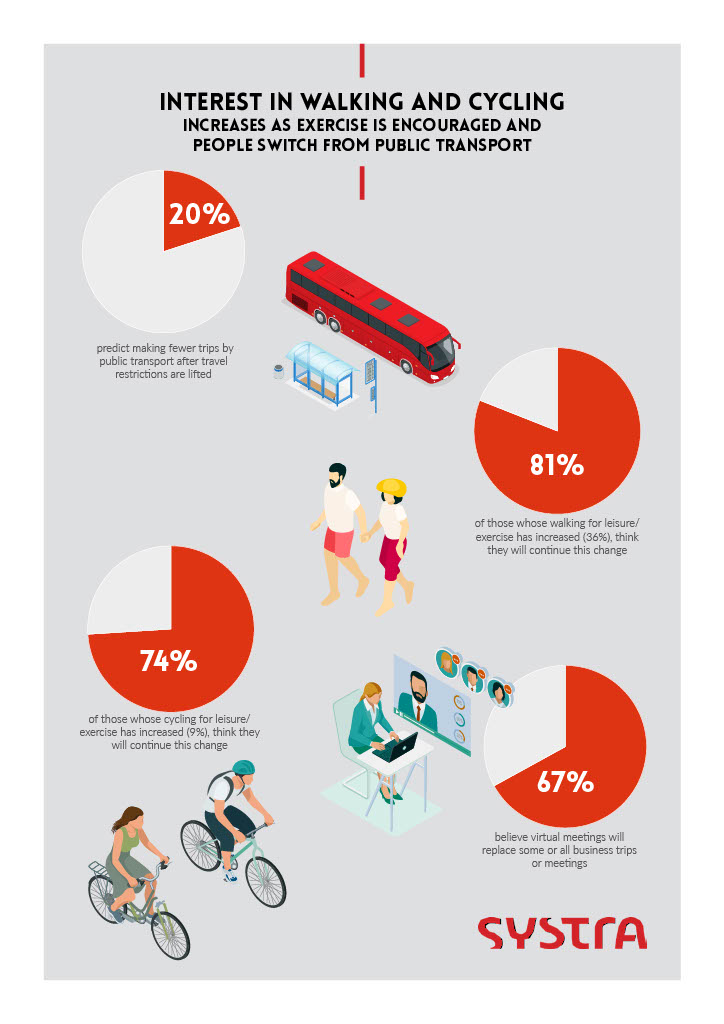
Many people are choosing to walk and cycle as part of their daily exercise ‘allowance’ and are swapping to active travel for other daily journeys during the current lockdown. Roughly four in five (80%) of them expect to continue this change.
One in five people expect to use public transport less once restrictions are lifted, and whilst ‘fear of getting ill’ is the main reason given, one in seven people say it is because they have found a new way to travel.
- Of those whose walking for leisure/exercise has increased (36%), 81% think they will continue this change.
- Of those whose cycling for leisure/exercise has increased (9%), 74% think they will continue this change.
Many pavements are less than 2 metres wide and pedestrians and cyclists are struggling with social distancing. Road traffic levels have fallen significantly, so there is an obvious opportunity to share road space more equitably, and possibly make these changes permanent. Our research shows that active travel will increase, even after travel restrictions are lifted.
Paul Osborne, Associate (Cycling Lead), SYSTRA Ltd
The research study also reveals a wider shift in working patterns as one in six (17%) of UK full or part time workers believe they will work from home more once COVID-19 travel restrictions are lifted. This is primarily to save the commute time and cost, and to provide a better work-life balance.
This predicted change in working location is the reason behind a quarter (24%) of the predicted reduction in public transport use. In addition, two-thirds (67%) believe virtual meetings will replace some or all business trips or meetings, further reducing the need to travel.
encouraged and people switch from public transportDownload Press Release
We found that 20% are predicting a decrease in their public transport use after COVID-19, compared with before the travel restrictions were put in place. Passengers also told us that this was because of concerns over getting ill, and because some commuters will be changing their working travel habits.

KEY FINDINGS INCLUDE:
- 20% predict making fewer trips by public transport after travel restrictions are lifted, rising to 27% for those who use rail to commute.
- Of those expecting to reduce their use of public transport, 49% will do so because of concerns over getting ill; 24% said they will work from home more; and 14% said they have found another way of making their journey.
- 17% of full and part time workers believe they will work from home more once COVID-19 travel restrictions are lifted. Reasons cited were saving the commute time and cost, and wanting a better work-life balance.
- 67% believe virtual meetings will replace some or all business trips or meetings.
- The survey covered the following regions: London, South East (excluding London), South West, West Midlands, East Midlands, Yorkshire and Humberside, North West, North East, East, Wales, Scotland, and Northern Ireland.
We are undertaking further behavioural modelling to understand the wider travel impacts on life after Covid-19 for UK cities and regions. More results will be added to this page, and our experts will be considering what the results could mean for wider society, climate change, different transport modes, different users, and across the different UK regions.
Supervising Civil Engineers (SCE), Delegated Engineers (DE) and Approved Mentors were invited to attend this forum which was an opportunity to receive an update on ICE approved training and professional development activities.
Employees who are currently mentoring, or planning to mentor others towards their professional qualification with the ICE (at EngTech, IEng or CEng) but are not formally registered as such, were also invited to attend.
The event took place after Elizabeth Thompson (Membership Development Officer for Yorkshire and the Humber) met with a group of our apprentices and degree apprentices in the morning.
SYSTRA awarded contract to deliver Rail Carbon Tool trainingThis web-based tool has so far been used on over 140 projects and allows users to undertake carbon footprint calculations of UK rail infrastructure projects. The results from the tool can be used to identify and select appropriate low carbon solutions, reducing whole life carbon with the potential for significant cost savings.
In line with the recently updated Network Rail, Environmental and Social Minimum Requirements, all rail infrastructure projects over £1 million will need to demonstrate that they have used the Rail Carbon Tool to identify opportunities for carbon reduction and to influence the specification of low carbon design and construction methods.
SYSTRAs’ Environment, Ecology and Sustainability team have used the tool successfully on projects in the past such as Oxford Station and Plumstead Depot and have an excellent working relationship with the RSSB, completing a research project for them last year and taking active roles in the Railway Industry Sustainability Forum and Carbon Management Working Group, both sponsored by the RSSB.
If you would like more information on the Rail Carbon Tool or the training course, visit the RSSB website.
SYSTRA Ltd Appoints Nick Salt as CEONick joins the company from Galliford Try where he was Managing Director for Infrastructure. Nick has spent over 20 years in the design and delivery of infrastructure in rail and the wider transportation industry.
Nick Salt joins the UK Management Team, whose current members include: Andrew McNaughton, Chairman; Steve Higham, Engineering Divisional Director; Richard Hancox, Consultancy Director; Lauren Lloyd, Human Resources; and, Tim Lewis, Finance and Business Services Director.

The appointment of Nick Salt marks a new chapter for the company and its commitment to the UK. Nick’s leadership in successfully running a £500m transport business with over 1200 employees together with his engaging people centred approach will be extremely valuable as we grow our business in the UK.
Andrew McNaughton, SYSTRA COO and SYSTRA UK Chairman

I am honoured to be joining SYSTRA at such a pivotal time, not only geo-politically, I believe our industry must establish how it responds to one of the most important issues facing our planet – climate change. SYSTRA is already developing new concepts and delivering solutions to bring communities closer together and it is my ambition to further develop SYSTRA’s growth in the UK substantially and sustainably.
Nick Salt, CEO, SYSTRA Ltd
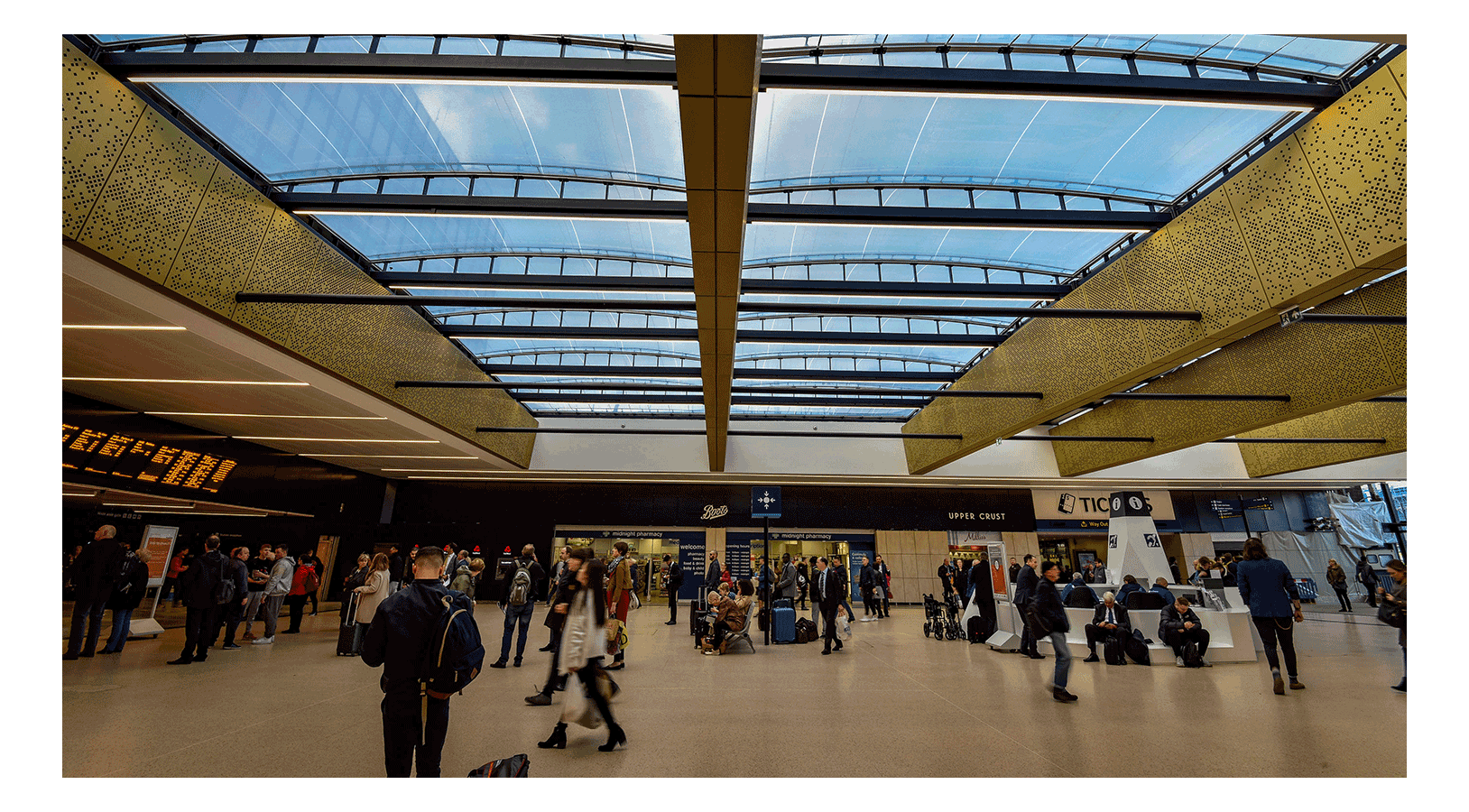
SYSTRA worked with Network Rail to deliver architectural design and project management of this ambitious renovation programme for the southern concourse in less than one year. The work involved the reinvention of the late 1960’s wooden roof and updates to the station entrance, Southern concourse retail space, ticket gateline and public WC facilities. New lighting and a gold entrance façade adds to the passenger experience, and all completed whilst the station remained open to the public 24/7.
The architecture and engineering team at SYSTRA worked collaboratively, boldly driving an ambitious programme and ensuring that the station renovations went beyond expectations. The project delivered additional design elements to create a wow factor for the 30 million passengers travelling through Leeds every year, delivering an aesthetically pleasing finish and a more secure, future proof station.
To maximise first impressions a gold metal façade was chosen, a transparent roof was created to allow natural daylight to flood the concourse and human circadian rhythmic lighting was incorporated into the design to mimic natural daylight. Natural lines were created inside the concourse to encourage the ‘flow of traffic’ through the space, subliminally encouraging passengers to move in the direction of the gateline.
The opportunity to transform Leeds Station was exciting and challenging for SYSTRA and our staff displayed passion and dedication to complete on time and to the highest standard. We are delighted to have the opportunity to deliver cutting edge improvements and a station lighting scheme that is unique in the UK.
CRAIG SCOTT, Managing Director, Strategy & Consultancy
Out with the old, in with the see through
With a brief from Network Rail to remove the dark and dated wooden panelling from its roof and ‘bring in more light’ to the concourse, the project team knew they had their work cut out to transform the space within a 24hr functioning station in just 11 months. To add to the complexity, the brief outlined the requirement for removal of asbestos, electrical cabling and oil-based paint finishes.
The designers team developed a solution using Ethylene Tetrafluoroethylene (ETFE) to allow natural daylight to flood through the roof whilst remaining strong, durable and long lasting. This translucent fluoride-based polymer sheeting offers notable high strength properties over a wide temperature range and high resistance to corrosion. The additional bonus of this material is that it’s light weight and quick to install, making it an ideal solution for the short timescale. The final result sees an impressive pillow design over two tiered levels, providing optimum amounts of light streaming through into the concourse.
Let there be light
In addition to the transparent roof, the team knew that on a dull overcast day, natural light would not deliver the full effect of the teams vision. To overcome this, the design incorporated a first for the railways by using a new lighting system, Human Circadian Rhythm Lighting (HCRL). Previously only used in the UK in a handful of care establishments, such as hospitals, HCRL mimics the light patterns of natural daylight with a cooler white light in the mornings and warmer yellow light in the evenings.
The technology behind the new lighting identifies with the human body’s need for rhythmic light patterns akin to the changing daily natural light cycles. In doing so, HCRL allows passengers to experience the same effect inside the station as that of the natural light patterns, resulting in the body clock remaining in sync and encouraging positive moods.
As good as gold
With the new entrance providing the main gateway to and from the city, the plans have involved the removal of the old, blue, square fronted canopy, making way for a new ‘pinched’ entrance canopy carrying a modern gold welcome into the city using anodised aluminium. Chosen for its light-weight and robust properties, the new gold façade provides a more upmarket first impression, tying in with the Southern entrance. The new entrance also includes new full height glazing, further enhancing the connections to New Station Street and the wider city centre.
Furthermore, old information boards and information points have been removed with new CIS, advertisement screens and a Customer Information Point installed to support a more intuitive passenger experience. The previous gateline caused passenger congestion, but the newly unveiled Automatic Ticket Gateline (ATG) arrangements are set to relieve congestion on both the concourse and platforms.
To complete the renovations, a new seated waiting area has been created at the southern concourse in between the entrance and the new Customer Information Point. This location has been carefully planned by the design team to create an obstruction-free flow of passenger traffic whilst allowing those waiting for their train times or loved ones to sit in a clutter free environment.
Other consultants working on the project for SYSTRA were M10 Fire, Fourways Telecoms, Kerbian, CCD, Buro Happold.
Balfour Beatty VINCI SYSTRA joint venture awarded HS2 contract for Old Oak Common stationThe joint venture will be responsible for the final design, construction and commissioning of Old Oak Common station in North West London, delivering six underground platforms as well as up to eight platforms on the adjacent Great Western Main Line.
Balfour Beatty’s in-depth expertise of constructing critical major transport terminals across the world will combine with VINCI’s knowledge in constructing high speed lines and UK rail infrastructure projects, and SYSTRA’s expertise in designing, integrating and project managing transport systems.

This award reflects the combined strength of our joint venture and recognises our world-class capabilities in designing, managing and delivering complex infrastructure projects. We look forward to applying our expertise to deliver this critical piece of national infrastructure so essential to driving the skills agenda, to the rebalancing of the UK economy and to the enabling of a resilient and competitive construction and infrastructure industry.
NIGEL RUSSELL Project Director for Balfour Beatty – (VINCI SYSTRA Joint Venture)
On completion, Old Oak Common station will become the UK’s best-connected station, providing direct services to three major airports, eight of Britain’s ten largest cities and forming part of one of Britain’s largest regeneration projects which will help create up to 65,000 jobs and 25,000 new homes in West London while also dramatically increasing rail capacity across the UK.
At construction peak the project will employ a direct management team of 140 and a wider workforce of approximately 2,500.

This latest contract award follows Balfour Beatty VINCI’s appointment in 2017 to deliver Lot N1 and Lot N2 of HS2’s main civil engineering works package in a two-part design and build contract, valued at c. £2.5 billion.
SYSTRA acquires TSP Projects doubling the size of its UK operationsThis investment reinforces SYSTRA’s longstanding commitment to the UK, where it has been active for more than 50 years. It is the company’s first major engineering acquisition in the UK and follows the acquisitions of SIAS Transport Planners in 2016 and JMP Consultants Ltd in 2015.
By acquiring TSP Projects, SYSTRA is cementing its position as a major UK force in engineering and consultancy for mass transit, mobility and complex infrastructure. SYSTRA is already number five globally among mass transit and rail international design firms*, and the acquisition places the company firmly alongside the UK’s leading consulting engineering firms.
The architecture and engineering team at SYSTRA worked collaboratively, boldly driving an ambitious programme and ensuring that the station renovations went beyond expectations. The project delivered additional design elements to create a wow factor for the 30 million passengers travelling through Leeds every year, delivering an aesthetically pleasing finish and a more secure, future proof station.
EXPERTISE IN EVERY ASPECT OF RAIL PROJECTS, DELIVERED THROUGH AN EXPANDED UK FOOTPRINT
From today, TSP Projects will continue to operate as TSP Projects and run as a business unit of our UK & Ireland operations. The combined company will provide clients with a complete end-to-end service spanning every aspect of rail projects, as well as specialist understanding of mobility and complex infrastructure.
It will deliver expertise across the full project lifecycle, from strategic advisory and design to systems integration, programme and construction management, testing & commissioning, and asset management. This expertise will be delivered through a significantly expanded UK footprint, providing clients with a highly localised service.
SYSTRA’s national and international experience in high speed rail, heavy rail, metro, light rail transit and transport consultancy, combined with TSP Projects’ extensive experience in the UK heavy rail sector, will create a leader in transportation solutions expert in all aspects of rail engineering, complex infrastructure and transport planning.
TSP Projects’ expertise in civil engineering, electrification and track will expand and complement SYSTRA’s UK rail engineering services, which include detailed design and the commissioning of integrated systems.
The combined company will also give clients access to new digital services, smart technologies, international expertise and proven innovation developed across SYSTRA’s global portfolio of mass transit and mobility projects.

As the signature team for transportation solutions, SYSTRA is committed to providing clients with truly specialist expertise, delivered locally. This acquisition is a gamechanger for our UK & Ireland business, placing us among the leading UK consulting engineering firms. This is a good fit between two like-minded companies with a shared commitment to excellence, safety and innovation. complete on time and to the highest standard. We are delighted to have the opportunity to deliver cutting edge improvements and a station lighting scheme that is unique in the UK.
Pascal Mercier, SYSTRA Ltd CEO
AN EXPANDED RANGE OF SERVICES FOR INFRASTRUCTURE OWNERS AND CONTRACTORS
UK clients will benefit from high-end, specialist technical expertise and high-quality production capacity across the full spectrum of design, engineering and programme/construction management. Serving infrastructure owners and operators, as well as contractors, the combined company will deliver specialist design & build, lead designer and programme management services.
SYSTRA is committed to driving TSP Projects’ expansion in sectors outside transportation, including energy from waste, modular construction and security.
This is a great opportunity for TSP Projects staff, clients and partners. SYSTRA is a like-minded organisation with similar values and a focus on technical excellence. SYSTRA ownership will bring with it all the benefits of a global engineering business including access to high calibre technical expertise to complement and enhance TSP Projects.
Craig Scott, TSP Projects CEO
A LONG-TERM FUTURE FOR TSP PROJECTS EMPLOYEES
TSP Projects staff will benefit from access to a broader range of opportunities through joining a 6,700-strong, global company with a 60-year track record in mass transit, mobility and infrastructure. TSP Projects employees will be able to apply their expertise to other markets and develop their skills in new areas and technologies.
The combined UK & Ireland team of more than 800 employees in 13 office locations will be able to export homegrown skills to clients across SYSTRA’s global operations in 80 countries.
SYSTRA’s Landmark Maritime Bridge Reference in KuwaitThis infrastructure, built on behalf of the Public Authority for Roads and Transportation (PART), the project owner, is one of the longest maritime causeways in the world and has even set a record: 34.1km of bridge over the sea. This new crossing brings Kuwait City closer to the future city of ‘Madinat Al-Hareer’ in the north, a future zone of economic activity, with the aim of creating a central hub in the Gulf by 2030. In designing this unique infrastructure, SYSTRA has confirmed its position as a world leader in bridge engineering.
| Some project figures | Some ‘Main Link’ project figures |
| 48.5km for the maritime crossing, of which 36.1km for the main link and 12.4km for the Doha Link 34.1km of bridge at sea (35.9km with the ramps) 2 artificial islands of 30 hectares each 2 reclamations of around 30 and 60 hectares A construction cost of 3.6 billion dollars 5 years of studies and construction | 1,510 bored piles 1,190 piers, 24 abutments 1,107 box girder spans, and 4 spans of in-situ cast slab bridge 12 spans with 72 precast I-beams and in-situ slabs 2 orthotropic box girders of 164m in length, for the cable-stayed bridge |
A REMARKABLE INFRASTRUCTURE
This bridge links the capital Kuwait City in the south of the bay of Kuwait to the Subiyah area in the north of the Emirate, by 36.1km of technical feats (Main Link). By adding the 12.4km section (Doha Link) enabling the Doha area to connect in the west, the structure is one of the longest maritime causeways in the world with a total length of 48.5km.
For five years SYSTRA worked for the consortium formed by the South Korean firm Hyundai E&C and the Kuwaiti company CGCC, and was entrusted with the responsibility for the complete design of the main link.
The Main Link comprises a maritime bridge 26.4km long including a cable-stayed bridge with a total length of 340m and a main span of 177m, an onshore bridge of around 4.5km ensuring connection with the Ghazali interchange, two artificial islands, two reclamations and two marinas designed by our sub-contractor Artelia Gulf, 30 buildings with a total surface area of 16,000m² for management and maintenance of the project’s infrastructure, among which a panoramic tower for visitors, as well as all electrical and mechanical systems. SYSTRA also carried out the assignment of independent checking engineering for the Doha Link for the South Korean firm GS E&C in charge of the construction.

INNOVATION AT THE HEART OF SYSTRA’S PROJECT
The accumulation of non-standard elements and technical challenges to overcome in a desert and marine environment pushed SYSTRA to implement leading edge technical and economic solutions never used before on such a scale.
“The bold option of proposing monopiles to support the structure, even in an unfavourable geological context, enabled stability, while significantly reducing seismic effects, the need for natural resources and the risk of concrete dispersion in the sea,” explains Mohamed Akraa, project director. The opportunity for SYSTRA to propose a world first: the precast in a dedicated casting yard of the entire prestressed 40 and 60m spans of 950 to 1,600 tons respectively using a pre-tension system was one of the keys to the project’s success. These construction methods enabled the impacts on marine ecosystems as well as the construction risks associated with offshore works to be significantly reduced.
INNOVATION AT THE HEART OF SYSTRA’S PROJECT
Between 2013 and 2016, 14,650 drawings were produced by the 250 SYSTRA experts involved in the project. The successful coordination of multicultural teams in France, India, Kuwait, Dubai and Korea was also crucial to the project’s success. “With management of the project in Paris, and with the support of the coordination team in Kuwait, we combined know-how, united cultural differences and managed time zone issues. These teams, interconnected perfectly as one, allowed us to successfully carry out the design within the specified timeframes,” added Mohamed Akraa.
SYSTRA Celebrates International Women’s Day 2019Their inspirational messages highlight the importance of the day as an opportunity not only to reflect on the past, but to think about how we can inspire future generations of women to enter the STEM industries, breaking down the barriers in what are perceived to be male dominated professions. Even more important is how, after today, we continue to engage in the debate around gender balance and aim to lead by example in our industry by creating a gender-balanced business.
1. WHAT DOES INTERNATIONAL WOMEN’S DAY MEAN TO YOU?
RON: (Graduate Transport Modeller): To me International Women’s Day is a day to celebrate every woman out there. Women started fighting for equal opportunities over 100 years ago, and I feel that fight has helped me become what I am today, hence this day should be celebrated.
ROSARIO (Project Director): I have mixed feelings about the day. On one hand is the realisation that we are still fighting for gender balance. But on the other hand, is a great day to discover and celebrate the achievements made by women.
ESHA (Assistant Consultant): To me, International Women’s Day is about breaking down the socially constructed barriers which lead women to feel inferior to their male counterparts. It is about being yourself, thinking that ‘I can do this,’ and overriding the typical ‘Barbie girl’ image of what is seen as ‘ideal’ and ‘preferred’ in society. It is about celebrating our differences, and putting aside our divisions, to unite and create progressive and equal opportunities.
CATHERINE (Civil Engineer): This is a day a certain quote below resonates most to me: “Here’s to strong women. May we know them. May we raise them, and most importantly, may we be them.”
2. WHAT MADE YOU DECIDE TO WORK IN AN INDUSTRY PERCEIVED TO BE MALE DOMINATED?
SHARON: The main reason I joined this industry is because of my interest in the Transportation field. Being in a male dominated industry came second to that, I have always been of the opinion that if a man can do it, then why can’t I? That spirit and perseverance has allowed me to become a member of the SYSTRA Ltd Family.
ROSARIO: I always loved architecture but was not very artistic. I also loved building things and I was good at maths, physics and chemistry so it was a no brainer for me to go into engineering. The thought of going into a male dominated industry never crossed my mind.
ESHA: I wanted to work in Transport Planning because of its relevance in society. I don’t believe that working in a male dominated industry should prevent women from reaching their aspirations and paving out a successful career pathway. For me, working in this industry was about my passion, resilience and determination, despite it being male dominated.
CATHERINE: Right from childhood, I have always had a passion for the built environment. But most of all, I was greatly encouraged and supported by my family and teachers to not be afraid to pursue my dream career.
3. WHAT WOULD YOU SAY TO FEMALE STUDENTS LOOKING FOR A TECHNICAL CAREER PATH?
SHARON: The main reason I joined this industry is because of my interest in the Transportation field. Being in a male dominated industry came second to that, I have always been of the opinion that if a man can do it, then why can’t I? That spirit and perseverance has allowed me to become a member of the SYSTRA Ltd Family.
ROSARIO: I always loved architecture but was not very artistic. I also loved building things and I was good at maths, physics and chemistry so it was a no brainer for me to go into engineering. The thought of going into a male dominated industry never crossed my mind.
ESHA: I wanted to work in Transport Planning because of its relevance in society. I don’t believe that working in a male dominated industry should prevent women from reaching their aspirations and paving out a successful career pathway. For me, working in this industry was about my passion, resilience and determination, despite it being male dominated.
CATHERINE: Right from childhood, I have always had a passion for the built environment. But most of all, I was greatly encouraged and supported by my family and teachers to not be afraid to pursue my dream career.
4. WHAT WOULD YOUR ADVICE BE FOR WOMEN WHO ARE JUST STARTING OUT IN YOUR INDUSTRY?
SHARON: I deeply relate to this question as I started out less than 6 months back. These past few months has taught me more than I could ever learn from books or lectures.
ROSARIO: Just be yourself, focus on your talent and don’t allow anyone to say that you don’t belong.
ESHA: I think for women starting out in this industry, it is important to be pro-active and get stuck in with the projects that you have been assigned, asking for help when you need it, while not being afraid to challenge the status quo. Furthermore, get to know and speak to senior women in the company you work for and wider through networking events.
CATHERINE: 1. Say yes to every opportunity that comes your way, even if you do not know the ‘how’, the process will be your teacher. 2. At the start, it will seem intimidating, but keep going it gets easier. Focus on your growth. 3. Do not get caught up in the ‘achieving your professional qualification in a certain time limit’, it is a process, you will eventually get there.
5. HOW DO YOU THINK WE CAN OVERCOME BARRIERS, ENCOURAGE AND NURTURE EMPLOYMENT AMONG WOMEN IN THE ENGINEERING AND TECHNICAL (STEM) INDUSTRIES?
SHARON: Honestly, I feel like there will always be barriers while working in such fields, but if you are confident enough and have a good support system such as good team mates, project manager’s, colleagues etc., that could make a world of a difference.
ROSARIO: While we are making progress, I think there is still a long way to go. The society is slowly getting educated to appreciate STEM and those barriers are slowly disappearing. Working with schools (including children, parents and teachers) is fundamental to change their perception and to encourage girls to consider engineering as a career path. Also with the arrival of new technology, the way we see and do engineering is changing rapidly. This is getting the attention of younger generations, so we must find ways to maximise this opportunity and encourage them to get more involved.
ESHA: I think perceptions about overcoming gender norms should be instilled from a young age, for example, LEGO’s are not just for boys, while dolls are not just for girls. It is important that STEM subjects and knowledge of future career paths is actively promoted to women in schools- there needs to be a ‘can do,’ positive attitude about women in STEM. More importantly, I think it is important that young women considering opportunities in STEM can talk women who are working in the industry, to help overcome any fears or misconceptions,
CATHERINE: I think one of the most important things we need is more mentorship, encouragement and support especially for the younger generation in the industry. At times we need to hear and echo the experiences of those who have excelled before us, in order to know that excellence in this male
6. WHAT MAKES SYSTRA A GREAT PLACE TO WORK FOR WOMEN?
SHARON: There are various reasons why working for SYSTRA is great, The work culture here is extremely friendly and light, my colleagues never treated me as a ‘New starter’ who was also an International student, they made me feel very welcomed from Day 1. Further a lot of the senior positions at SYSTRA are held by women, which makes you think that that could be you one day if you work hard enough and not give up on your dreams.
ROSARIO: I am valued as a professional who can contribute to the growth of the business. I also feel that SYSTRA promotes the development of talent and allows you to thrive. Just look at the number of women and the average age of our workforce.
ESHA: The people at SYSTRA make it such a great place to work, for everyone. Importantly, at SYSTRA there is an equal respect for everyone, no matter what gender, race or grade; you are valued. There are a number of successful women in the office who inspire me, through their commitment, knowledge and morals. The best thing is, they are always willing to offer you advice or just have a general chat with you, whether about technical skills or about the latest BBC drama. And yes- I have found myself saying, ‘I want to be like her,’ when working with my line manager and others in the office.
CATHERINE: SYSTRA has taken great initiative in supporting women including a notable number of women being recruited in STEM job opportunities and offering quite good incentives that support women including flexible working
7. HOW DO YOU THINK WE COULD STRIKE A BETTER BALANCE IN OUR INDUSTRY AND IN SYSTRA #BALANCEFORBETTER?
SHARON: I think a better balance could be developed by providing equal opportunity to all and having a diverse group of employees as that would definitely make an organisation more innovative and competitive.
ROSARIO:
Existing role models in the industry and at SYSTRA have a massive role to play in breaking potential barriers. They have the option to influence people to brake any existing barriers, but also to motivate people to thrive and develop their talent to achieve gender-balanced boardrooms for example.
The use of social media can be very powerful to raise awareness, to encourage younger generations to take action but also allows them to find organisations (like SYSTRA) and people (like me!) that share their views and values.
ESHA: I think the first step for this industry is to not be afraid to talk about the issues relating to the lack of number of women in transport planning and engineering. The industry needs to promote diversity through focusing on the best talent, no matter what gender. The industry needs to show its openness to achieve #BalanceforBetter through collaboration of different companies, and acknowledging the amazing women we have in the industry today. It’s also very important that it is recognised that attitudes towards gender equality vary around the globe. As SYSTRA has a global presence, #BalanceforBetter needs to be a key movement in giving more women the confidence to pursue such a career.
CATHERINE: For starters, we could try and have gender balance in all sectors for instance in the different committee boards in the industry, a gender-balance of employees at work and within leadership roles.