

 Australia
  Brazil
  Canada
  Chile
Chile  China
China  Columbia
  Denmark
  Egypt
Egypt  France
  India
India  Indonesia
  Ireland
  Italy
Italy  Malaysia
  New Zealand
  Norway
  Panama
  Peru
Peru  Poland
  Portugal
  Saudi Arabia
  Singapore
  South Korea
  Spain
Spain  Sweden
  Taiwan
  Thailand
  Türkiye
  United Kingdom
  United States
  Vietnam


At SYSTRA, we don’t ‘use AI for AI’s sake.’ We use it where it truly improves our performance and, consequently, the quality and timelines of our projects. For us, it represents a set of tools and technologies with significant disruptive potential and, as such, a driver of evolution in our professions.
AI has been introduced gradually at SYSTRA and is now used in a variety of ways, all with the same goal: to accelerate the implementation of more efficient and resilient transportation systems, responsibly and collaboratively, for the benefit of our experts and our clients.

A Gradual adoption of AI
AI has been progressing at SYSTRA for many years, in line with real needs, the validation of use cases, and the maturation of technologies.
The first major phase of development, beginning in the 2010s, led to mastery of statistical models and data, notably illustrated by SYSTRA’s expertise in digital twins and modelling techniques.
The second phase concerns so-called productivity AI, notably embodied by large language models (LLMs), which has seen significant acceleration since 2022. It, too, has been progressively integrated into everyday use within a secure framework. It now provides cross-functional services for faster searching, analysis, and writing when the context allows.
Building on these successful integrations, the third phase should lead to the development of a truly augmented AI engineer, a full member of an integrated team, capable of automating certain tasks and operating with essential safeguards related to security and ethics.
“As part of our innovation strategy, we launched a dedicated AI stream to identify the activities that could benefit most from it,” comments Amine Triki, Principal System Engineer. “The idea is obviously not to replace engineers, but to assist and augment them. AI should allow us to do better: design more efficient infrastructure with a reduced environmental impact, improve performance across the entire lifecycle, and strengthen our ability to simulate before building.”
This organisation, which combines a spirit of innovation, technical pragmatism, responsibility and acculturation, constitutes a prerequisite for the generalisation of use cases, some of which are already bearing fruit.
Case Study #1: In Canada, optimise a track alignment with AI, by Christopher Salhany
Our Canadian subsidiary has developed an AI toolkit that assists our design teams in identifying the best rail corridors and then optimising track design within those corridors.

The approach is progressive: it first involves identifying a geometrically acceptable passage area, based on a digital terrain model and design constraints (e.g., minimum curve radius and maximum gradient), and then refining the alignment using iterative algorithms that compare different options. Earthwork costs and track length are considered from this early stage to guide the choices, using GIS (Geographic Information System) layers that describe the terrain, bodies of water, and inhabited or protected areas.
The expected benefit is to quickly eliminate less relevant options and focus on the analysis of credible alternatives. The criteria can be weighted according to the study’s objective: prioritising CAPEX (capital expenditure) when the main issue is construction cost or balancing them differently when other parameters take precedence.
The aim is to equip the study with the tools needed to reduce exploration times and objectively compare options on a consistent basis. Ultimately, the system will be able to incorporate additional tools and criteria (carbon footprint, climate resilience, usage metrics) and be extended to other types of infrastructure by adapting the design parameters.
Use Case #2: Designing a Bridge with AI Bridge Design, by Mathieu Muls
To design a new bridge, structural engineers currently rely solely on projects they have personally worked on throughout their career and those they have encountered in technical literature.
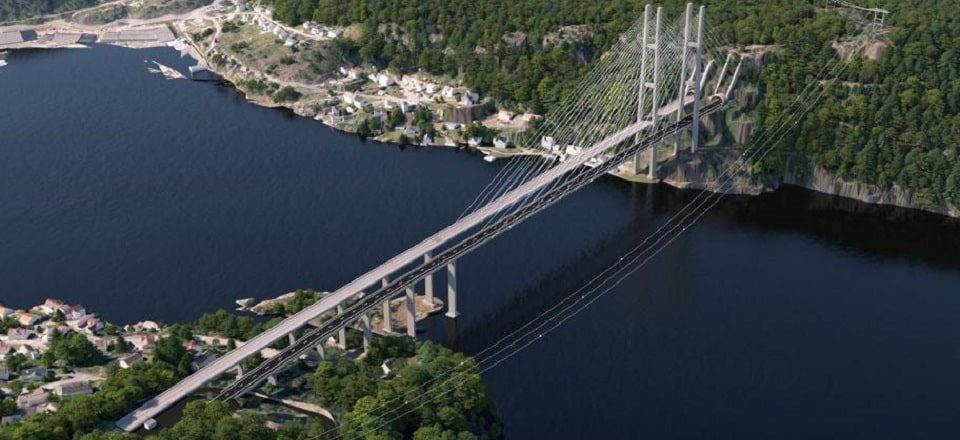
However, using a database can, in a way, indirectly draw upon the experience of hundreds of engineers who have designed thousands of bridges worldwide. The AI Bridge Design software developed by SYSTRA allows engineers to find existing documented projects in a large international database. To remain relevant, this bridge database must evolve and be continuously enriched to incorporate the latest practices.
The AI Bridge Design software acts as an aid to engineers, suggesting intuitive bridge concepts based on the provided input data. AI serves as a tool for questioning and optimising solutions for the engineer. It remains the engineer’s responsibility to validate these concepts using their knowledge and expertise in the field of civil engineering structures. The relevance of the results provided must always be verified by the engineer.
This tool is particularly useful in the early stages of the study (feasibility and preliminary studies) where the bridge design may still be subject to review or modification. The software is most useful for bridge projects with diverse obstacles (watercourses, roads or railways, buildings, etc.). In these cases, the optimal solution emerges from a complex balance between numerous requirements.
From a geographical perspective, the use of AI may be more useful in countries that are open to innovation and where the focus is often on the economy, rapid construction, or even the pursuit of iconic structures. In this context, AI can make a valuable contribution.
This use case paves the way for the broader application of AI in the design sector, as a powerful decision-support tool capable of assisting engineers in their trade-offs and enhancing the overall quality of developed projects.
Case study #3: On projects, review the technical requirements with Verify, by Mathieu Martin
During the design phase of rail transport systems, SYSTRA’s technical teams must often produce or revise tens of thousands of technical requirements within a project.

It is in this context that SYSTRA’s Innovation department launched the Verify programme to help its experts more easily identify inaccuracies and errors in large requirements datasets. By exploring the combined contribution of semantic and generative AI, Verify aims to detect ambiguities, inconsistencies, and potential contradictions as early as possible, thereby better prioritising expert review. Multiple functionalities are being studied with this in mind, including editorial standardisation, thematic classification, and the identification of conflicts between requirements.
Conducted with various international teams within the SYSTRA Group and an external partner, Verify is part of a structured experimentation process and a gradual increase in maturity. The technical choices aim to enhance the capabilities of experts without replacing their judgment, with particular attention paid to the traceability of analyses and integration with the teams’ tools and practices. All of this is carried out within a strict data protection framework, always guaranteeing the confidentiality of processed data.
At this stage of the programme, SYSTRA’s ambition is to assess the concrete contributions and limitations of the tested approaches, with a view to a wider deployment within the Group should the benefits be confirmed.
Use Case #4: In the UK, Road Safety and Mapping of Technical Networks with Collision Seek, by Llewelyn Morgan
At the end of 2024, our subsidiary SYSTRA UK & Ireland received government funding to explore the contribution of AI and computer vision to the analysis of road accident environments.

The tool developed, Collision Seek, uses open data to categorise intersection configurations and detect where the risk of collision is most likely, based on consistent observation. It allows users to select an area, generate a report and quickly obtain information on the typical risks of an existing intersection or a design variant, thereby leveraging large amounts of data without automating the decision-making process.
In a different area, UK teams have used AI to industrialise the consolidation of data from underground utility networks (water, electricity, gas, telecommunications). The traditional process, based on multiple requests, manual georeferencing, and map-by-map vectorisation, has been reconfigured into a semi-automated workflow that combines scripts, computer vision, and geospatial tools to automatically georeference plans and extract relevant areas.
Initial results indicate a time saving of 80 to 90% compared to the traditional method, with increased accuracy that reduces the risk of errors that could lead to incidents in the field. The value lies not only in the time saved: the consistency of the process feeds a single, reusable repository that is easier to maintain and can be used across projects.

Acculturation and skills development
Beyond project-based use cases, SYSTRA is investing in its teams’ understanding and adoption of AI tools. The goal is for everyone to be able to identify a need, choose the right approach, and assess the quality of the results. Dedicated sessions have been launched for managers and teams to provide common benchmarks.
As Mathieu Martin, Innovation Project Manager, explains, the challenge is “for everyone to understand the possibilities and limitations of AI solutions, and for us to establish a technical and methodological foundation that will allow everyone to grasp the subject at their own level.”
The usage framework is also clarified regarding clients and project data. SYSTRA does not develop proprietary models on internal data, and particular attention is paid to AI-related clauses in contracts to meet the varying expectations of different countries and project owners. This position, which prioritises trust and traceability, is accompanied by educational efforts to explain the true meaning of the term ‘AI’ (from simple automation scripts to machine learning systems) in order to avoid misunderstandings in practice.
Today at SYSTRA, we are developing secure, ethical and sustainable artificial intelligence. We measure the environmental footprint of our use of AI to ensure that we are not only doing things faster, but smarter and cleaner. The goal is responsibility and impact: better outcomes for passengers, operators and cities.