

 Australia
  Brazil
  Chile
Chile  China
China  Columbia
  Denmark
  Egypt
Egypt  France
  India
India  Indonesia
  Ireland
  Italy
Italy  Malaysia
  New Zealand
  Norway
  Panama
  Peru
Peru  Poland
  Portugal
  Saudi Arabia
  Singapore
  Spain
Spain  South Korea
  Sweden
  Taiwan
  Thailand
  Türkiye
  United Kingdom
  United States
  Vietnam



COME AND VISIT US!
Our hydrogen professionals will be on hand to discuss new solutions to support your future projects.
Decarbonated hydrogen is a promising solution for energy transition and the fight against climate change.
Collaboration between national and international political and economic players is essential to share projects and research, and stimulate the industry through partnerships. Hyvolution, as a major professional platform, plays an accelerating role in promoting commercial, international and political dialogue, actively contributing to the development of the decarbonized hydrogen sector.
TO MEET US
HYVOLUTION HUB
1. Download the “Hyvolution Hub” on your smartphone
2. Click on Community
3. Search for our experts
contact our expert
JOHANN BUREAU
Technical Director, Hydrogen – Transsit
📳 Cell / WhatsApp: +1 367 330 9022
The results of the American magazine ENR once again illustrate the growth of the Group’s international sales. These two new positions put SYSTRA on the podium of engineering firms in the Mass Transit & Rail and Bridges categories.

These rankings, which are based on 2023 turnover, are in addition to the results published in August:
- #6 in the Top 10 Transportation firms, which compares sales in the field of mobility,
- #22 in the Top 225 International Design Firms, which compares international sales figures (outside France for SYSTRA),
- #40 in the Top 150 Global Design Firms, which compares turnover worldwide (including France).

I am very proud to announce that, in the 2024 edition of the Engineering News-Record Global Sourcebook, SYSTRA has made further progress in two categories, achieving 2nd place in the Mass Transit and Rail category and 3rd place in the Bridges category. We are once again the leading French company in these rankings. This new progression confirms the relevance of our strategy of specialisation and focus on excellence. It rewards the hard work and commitment of our Connected Teams.
Jean-Charles Vollery, Président du Directoire
ENR is the leading American magazine in the international engineering sector. Every year, it ranks engineering and civil engineering companies based on their domestic and international sales figures.
Find Engineering News-Record publications on their website.
Complete modernisation of the signalling for the Paris-Lyon high-speed line with SYSTRA101 hours to change everything: this is the network challenge that teams from SYSTRA France, Eiffage Énergie Systèmes (lead), Saferail and TGSO have been preparing for since 2019 as part of the LGV+ programme, also known as HPGV (Haute Performance Grande Vitesse).
Brought into service in 1981, the Paris-Lyon line is the oldest LGV in Europe and the busiest, with up to 13 trains per hour. Equipped with an old signalling system, its two tracks were completely regenerated by computerised signal boxes during an operation organised over the long weekend of November 11. The aim? To enable migration to the interoperable ERTMS level 2 system by 2026.
More than 400 km of high-speed line to equip
SYSTRA was project manager for the design of the LGV’s 58 technical buildings, which house the line’s computer stations, from working drawings to technical checks. Our teams also drew up the technical plans for 33 signal boxes and took part in the technical checks on the entire line.

Since November 13, the signalling installations on the LGV Sud-Est line have been controlled from a new control tower based in Lyon. Now equipped, the 409-km Paris-Lyon line will be more reliable, resilient and interoperable, enabling trains from all over Europe to run on it. This will further increase the number of connections on this line in 2030, with up to 16 trains per hour in each direction.

This switchover is a world first and represents the culmination of almost five years of studies. SYSTRA France has been involved in all phases of the project since 2019. This is the first time that SNCF Réseau has outsourced so many tasks, and we are proud of the confidence they have shown in us.
Marc Bogaert, project manager, FIT (Railways), SYSTRA France
ERTMS: SYSTRA in pole position for signalling changes
ERTMS, the backbone of interoperability and the harmonisation of railway operations, is gradually being rolled out across Europe. SYSTRA is contributing to this with numerous migration missions in Italy, Sweden and Denmark. In the second half of 2024, SYSTRA won the ERTMS migration contract for the Channel Tunnel and the HS1 high-speed line between London and Folkestone, which will improve the UK’s links with the European rail system.
California Transit Association’s 59th Annual Fall Conference & Expo

SYSTRA Canada was proud to collaborate with RATP Dev USA to mark its presence at the California Transit Association’s 59th Annual Fall Conference & Expo, a must-attend event for leaders in sustainable mobility in North America.
Along side RATP Dev, our experts, Vincent Berducou, Director, Urban Systems Operation, Maintenance & Electromobility and Carlos Hernandez, Systems Integrator Specialist, were on hand to discuss emerging trends and technologies that are redefining the sector, including electromobility and environmentally-friendly solutions.
With interactive exhibits, high-level panels and targeted networking opportunities, this was a unique opportunity to propel our ideas forward, develop synergies and contribute to a greener future well beyond California.
With RATP Dev USA, SYSTRA Canada showcased innovative electromobility solutions that meet the environmental challenges and growing needs of urban transit systems. This strategic collaboration reflects our shared commitment to transforming modes of public transport by focusing on sustainable, high-performance technologies.

Reducing journey times for motorists
The Sarıyer – Kilyos Highway Tunnel Project will ensure high standard direct transportation between two strategic locations in İstanbul, from the Third Bosphorus Bridge to southern parts of the city. For motorists journey times will be reduced, as well as air and noise pollution.
Designed entirely by SYSTRA Türkiye’s underground experts, the Sarıyer – Kilyos tunnel will soon be dug by a tunnel boring machine (TBM). This machine, with a cutting diameter of 13.75 metres, is currently being assembled deep underground in Istanbul, in a cavern of impressive dimensions:
- 75 m long
- 30 m wide
- 24 m high
- That’s two 600 m² tympanums on either side of the cavern.

When it is put into action, the TBM will begin by assembling the first rings of segments to form a pre-tunnel, then will pierce the spandrel where the steel reinforcement has been specially designed to be perforated.

Our team designed the cavern tunnel from scratch, focusing on safety and operational efficiency. In addition to providing design services, we monitored and reported on the excavations and geological conditions from the start of tunnel construction and our team regularly reviewed field data, comparing it with our design and models.
Mustafa Erdem Ispir, Head of Tunnelling & Geotechnical Department, SYSTRA Türkiye
It was a big challenge for us to meet the site requirements in a short period to match with the construction schedule with this special cavern tunnel. Eventually, it will be rewarding for all the team to see this in reality and a big milestone for the project as the TBM will be placing the first ring soon.
Buse Ecem Akcor, Project Manager, SYSTRA Türkiye

Opening of the 7-km tunnel is scheduled for the end of 2026.
Latour Capital and Fimalac finalize their investment in SYSTRA, becoming shareholders alongside RATP Group and SNCF GroupIn the fast-growing public transport market, this transaction is aimed at supporting the growth and international development strategy of SYSTRA, which operates in 80 countries.
SYSTRA employs over 11,000 people around the globe, and is one of the world’s top engineering and consulting groups specializing in public transport and mobility solutions. The arrival of new shareholders Latour Capital and Fimalac will help strengthen its position as a global champion in sustainable mobility.
After 13 years at the helm, Pierre Verzat has taken this opportunity to step down as CEO and head of SYSTRA’s Management Board. His successor is Jean-Charles Vollery, who will be pursuing and accelerating SYSTRA’s development.

We are delighted to welcome Latour Capital and Fimalac as shareholders alongside our legacy investors SNCF and RATP. Opening up our capital is a major step in expanding our business, as we move to grow our market share in high-potential regions. I am happy to have been able to contribute to this major transformation. But it’s also an opportunity for me to step back, and I am delighted to be handing the reins over to Jean-Charles Vollery, who has put his passion and talent to work for us for over 28 years.
Pierre Verzat, CEO and head of the SYSTRA Management Board
I am excited to grow our business further, while preserving a brand to which I am deeply attached. And I am committed to placing customer satisfaction and the well-being of our people at the heart of this shared ambition.
Jean-Charles Vollery, Chief Operating Officer and future CEO and head of SYSTRA’s Management Board

Jean-François Beaudoin, Senior Partner at Latour Capital and the new Chairman of SYSTRA’s Supervisory Board, added: “SYSTRA operates in an extremely buoyant market, boasts unique and sought-after expertise, and we have every confidence in its growth potential. We are proud to lend our support as it works to achieve its goals around the globe. We would like to thank Pierre Verzat for his outstanding contribution to SYSTRA’s growth and are fully confident in Jean-Charles Vollery’s ability to pursue the company’s successful journey.”
Marc de Lacharrière, Chairman and CEO of Fimalac, said: “As part of our strategy of supporting forward-thinking industry leaders with strong international growth prospects, Fimalac is delighted to team up with Latour Capital, SNCF and RATP to write this new page in the history of SYSTRA, the French champion in engineering for sustainable mobility solutions.”
Jean-Yves Leclercq, head of Strategy, Finance and Sustainable Performance at RATP Group, commented: “Since its re-foundation in 2012, under the leadership of Pierre Verzat and with the support of its industrial shareholders, SYSTRA has become an international champion in transport engineering, tripling its turnover and significantly improving its operating performance. By opening up its capital to Latour Capital and Fimalac, we wanted to enable SYSTRA to open up a new chapter in its history, which will enable it to accelerate its development. RATP, by retaining 20% of SYSTRA’s capital, is continuing the adventure alongside SYSTRA.”
Laurent Trévisani, Deputy CEO Strategy & Finance at SNCF Group, said: “At SNCF Group, we are proud of our role in co-founding a world-class company capable of promoting French railway engineering excellence globally. That was 65+ years ago. Since 2011, under Pierre Verzat’s leadership, SYSTRA has made a name for itself in the world arena, and we will continue to lend our active support to its growth trajectory.”
In April 2024, SNCF Group and RATP Group announced that they were entering into exclusive negotiations to allow Latour Capital and Fimalac to become shareholders of SYSTRA.
ENR 2024: SYSTRA moves up again in the latest rankingsIn the Transportation ranking, which includes the 2023 international sales figures of the ten largest engineering companies in the mobility sector, we have moved up two places to 6th position, having already moved up one place last year. We are the leading French company in this ranking.
In the Top 225 International Design Firms, which covers the international turnovers of companies in all sectors, the Group moved up two places to 22nd, after having gained 2 places in the last two years, which puts us in the Top 25.
SYSTRA therefore continues to grow in the transport sector and in key geographies.
We have also moved up 5 places in the world’s Top 150 Global Design Firms, where we are now ranked 40th. We are therefore continuing to move steadily closer to the performance of the world’s leading companies.
The rankings for the Mass Transit & Rail and Bridges categories will be announced in December when the Global Sourcebook is published.
This new progression confirms the relevance of our strategy of specialising in the transport engineering market. It’s a vote of confidence from our clients, rewarding the work and commitment of our connected teams.
Pierre Verzat, CEO, SYSTRA
ENR is the leading American magazine in the international engineering sector. Every year, it ranks engineering and civil engineering companies based on their domestic and international sales figures.
Find Engineering News-Record publications on their website.
High-speed lines: SYSTRA makes its mark in California and Morocco with two new projectsIn the US, SYSTRA, as part of a consortium with TYPSA, has won the engineering contract for the central section of the high-speed line between Merced and Bakersfield, in California. Spanning 275 km, this is the first complete line with both track and catenary to be launched in the US – the backbone of California’s future high-speed network. This new contract is in addition to a previous contract signed in November 2022 through Stantec for the execution studies for the infrastructure of this high-speed line between Merced and Madera.

In Morocco, as part of a consortium alongside Egis and Novec, SYSTRA has signed a project management assistance contract for the extension of the high-speed line between Tangiers and Kenitra as far as Marrakesh. This new infrastructure will enable trains to run at 320 km/h over 430 km of new high-speed lines, establishing Morocco’s new railway network as one of the most modern and high performance in the world. The project is slated to be brought into service at the end of 2029, right before the start of the football World Cup. SYSTRA was already a partner in the first Moroccan high-speed line, which entered into service in 2018, as project manager for the longest section of civil engineering and project management assistant for all rail and electromechanical equipment.
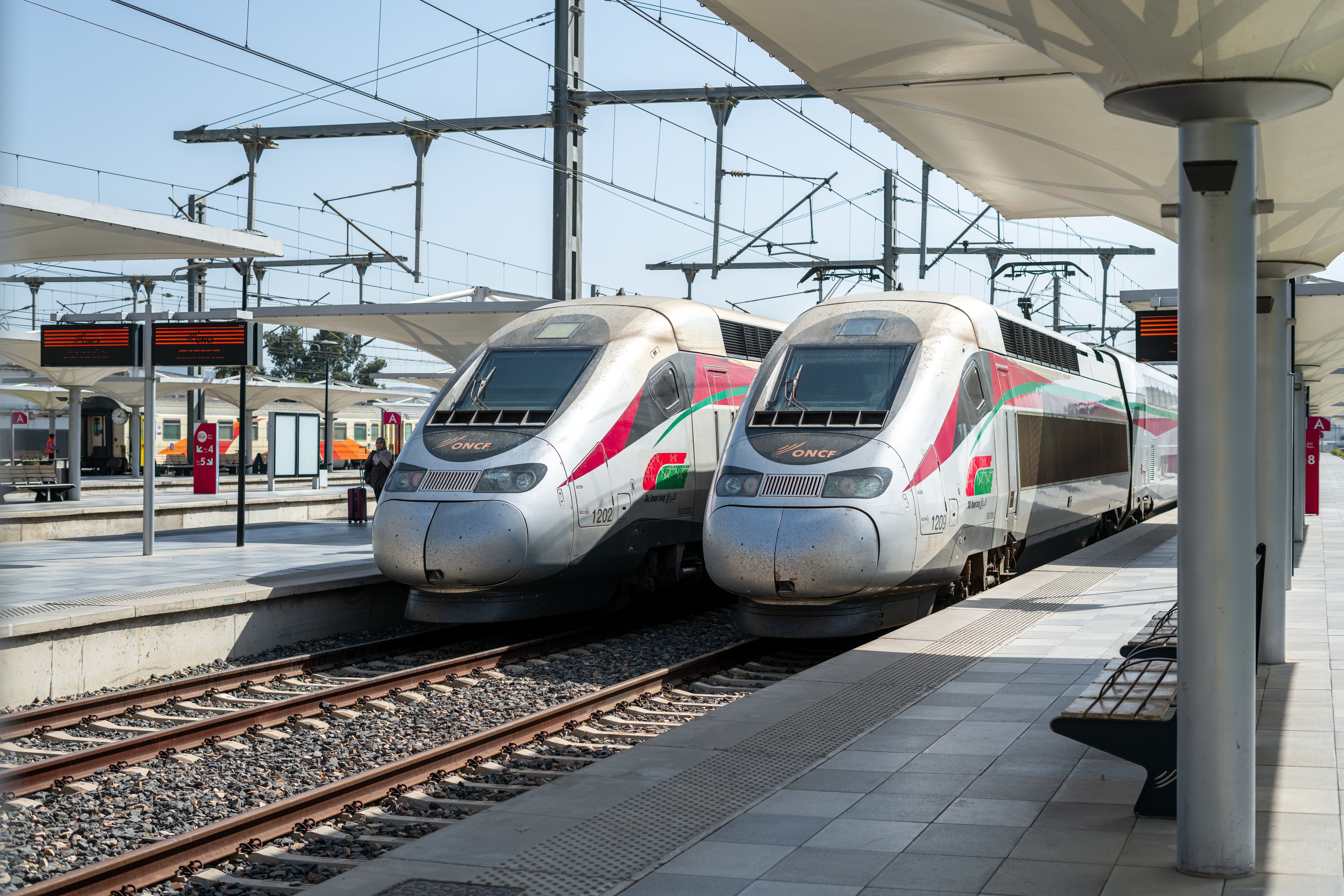
SYSTRA responds to the boom in high-speed rail throughout the world
The Group is actively contributing to high-speed networks in other regions of the world. In Oceania, SYSTRA Australia & New Zealand, in a consortium with Arup, has signed a contract to support the planning of the future high-speed network on the east coast of the country, on behalf of the High Speed Rail Authority. Our teams are responsible for studying the operating and maintenance requirements for the first section between Sydney and Newcastle. This line, the busiest of the current regional trains with almost 15 million passengers a year, will be the backbone of a vast high-speed corridor linking Melbourne to Brisbane.
In India, the firm is working on the ticketing system for the high-speed line between Mumbai and Ahmedabad to facilitate the passenger experience, while in the United Arab Emirates, SYSTRA has been working as Project Management Consultant on the preliminary studies for the link between Abu Dhabi and Dubai since end of 2021. In Spain, SYSTRA is in charge of the engineering for a section of the Cantabrian-Mediterranean High Speed Line, a project designed to promote regional and national mobility thanks to this new link between the north and south of the country.
Finally, in the United Kingdom, SYSTRA is a key player in the development of the new HS2 high-speed network between London and Birmingham, with major contracts for the construction of the new multimodal station at Old Oak Common as part of the Balfour Beatty – VINCI joint venture, and for studies of the Birmingham approach section to the north, in a consortium with Mott MacDonald on behalf of Balfour Beatty – VINCI.
These successes and major rail transport projects embody SYSTRA’s international dynamism and bear witness to its world-renowned expertise. The Group is thus confirming its key role in building a future where mobility is fast, safe and respectful of the environment.
Cadence submits its response to the Request for Proposals for the HFR Project
The Government of Canada is expected to announce its selection of the preferred partner at the end of this year.
In the meantime, the Cadence team is continuing to collaborate in the procurement process.
During the development of its proposal, the Cadence team welcomed new partners. Air Canada and SNCF Voyageurs have joined the Cadence team, which already includes CDPQ Infra, SYSTRA Canada, AtkinsRéalis Canada and Keolis Canada. Recognized for their expertise in the design, development and operation of infrastructure and passenger transportation, these organizations are bringing all their extensive knowledge to this fundamental project for Canadians.
In October 2023, the Government of Canada launched a Request for Proposals for the HFR project in the Quebec City-Windsor corridor, designed to link Quebec City, Montreal, Ottawa and Toronto. In order to contribute to the realization of this major project, the Cadence team submitted a proposal that will meet connectivity and mobility needs, while respecting communities.
Source: Cadence
