 Australia
  Brazil
  Canada
  Chile
Chile  China
China  Columbia
  Egypt
Egypt  France
  India
India  Indonesia
  Ireland
  Italy
Italy  Malaysia
  New Zealand
  Norway
  Panama
  Peru
Peru  Poland
  Portugal
  Saudi Arabia
  Singapore
  South Korea
  Spain
Spain  Sweden
  Taiwan
  Thailand
  Türkiye
  United Kingdom
  United States
  Vietnam


Light rail is a central part of urban infrastructure: high surface-level capacity, short construction time, and a low carbon footprint that is felt from the first day of operation. It connects housing and workplaces, relieves pressure on the road network, and provides reliable, accessible transport—often with lower operating costs than buses at high passenger volumes. At the same time, light rail acts as a catalyst for urban development: station-adjacent areas become denser, public spaces are enhanced, and journey times become more predictable, all while requiring significantly less space than traditional road expansions.
International and local experience
At SYSTRA, we work across disciplines from the earliest concept stage through to operations. This means that rail, road, public realm, electrical and signalling engineers, geotechnical specialists, and transport planners develop solutions within one integrated process. We place strong emphasis on early risk identification, realistic phasing designs, and close collaboration with authorities and utility companies, so that conflicts are identified and resolved before they have an impact. Our international experience from light rail projects is combined with local conditions, standards, and delivery practices—and our digital workflows make it easier to manage changes, document decisions, and ensure traceability.

Vestre strandallé in Aarhus
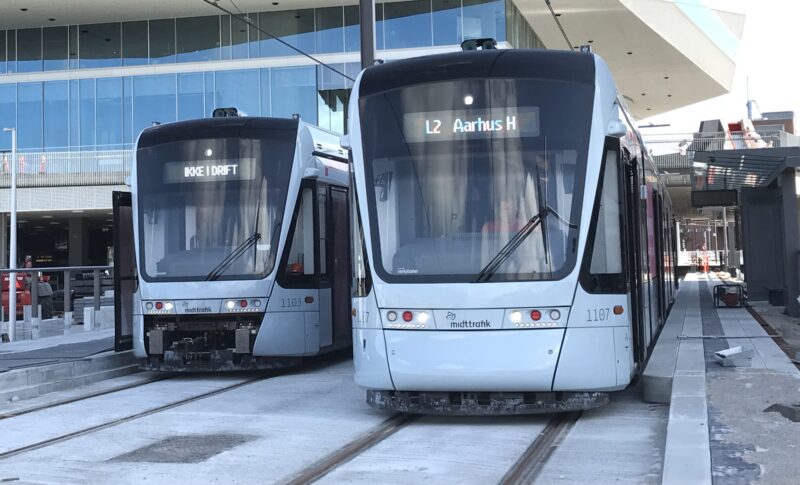
A new passing station at Vestre Strandallé has increased capacity and made operations more robust, enabling more frequent services between Hornslet and Aarhus Central Station. The new passing track allows light rail vehicles to pass each other at this location, while the new platform brings the station together and improves the connection to the bus stop.
SYSTRA delivered the project as lead consultant in close collaboration with Aarhus Letbane I/S, Aarsleff Rail A/S, and Railtech.
services
We work with different kinds of services within light rail:
- Strategic planning, traffic and passenger analyses, as well as business case and economic assessments
- Alignment planning, route and station design, including public realm, accessibility, and multimodal integration
- Geotechnics, excavation works, drainage and pavement design, as well as utility diversion management
- Rail engineering: trackform, sizing, superstructure/substructure, and vibration/noise mitigation
- Systems: power supply, including catenary and catenary-free solutions, signalling, SRO/SCADA, communications, and safety
- Bridges, tunnels, and special structures along the route
- Traffic management, temporary solutions, and phasing design in urban environments with operations maintained during construction
- Regulatory approvals, EIA/environmental matters, easements, and stakeholder management
- Procurement strategy, contracting, including design and build and alliances, as well as requirements management and design assurance
- Construction management, supervision, testing and commissioning, RAMS, and operational readiness
- Asset management, maintenance strategy, and lifecycle optimisation