 Australia
  Brazil
  Canada
  Chile
Chile  China
China  Columbia
  Denmark
  France
  India
India  Indonesia
  Ireland
  Italy
Italy  Malaysia
  New Zealand
  Norway
  Panama
  Peru
Peru  Poland
  Portugal
  Saudi Arabia
  Singapore
  South Korea
  Spain
Spain  Sweden
  Taiwan
  Thailand
  Türkiye
  United Kingdom
  United States
  Vietnam

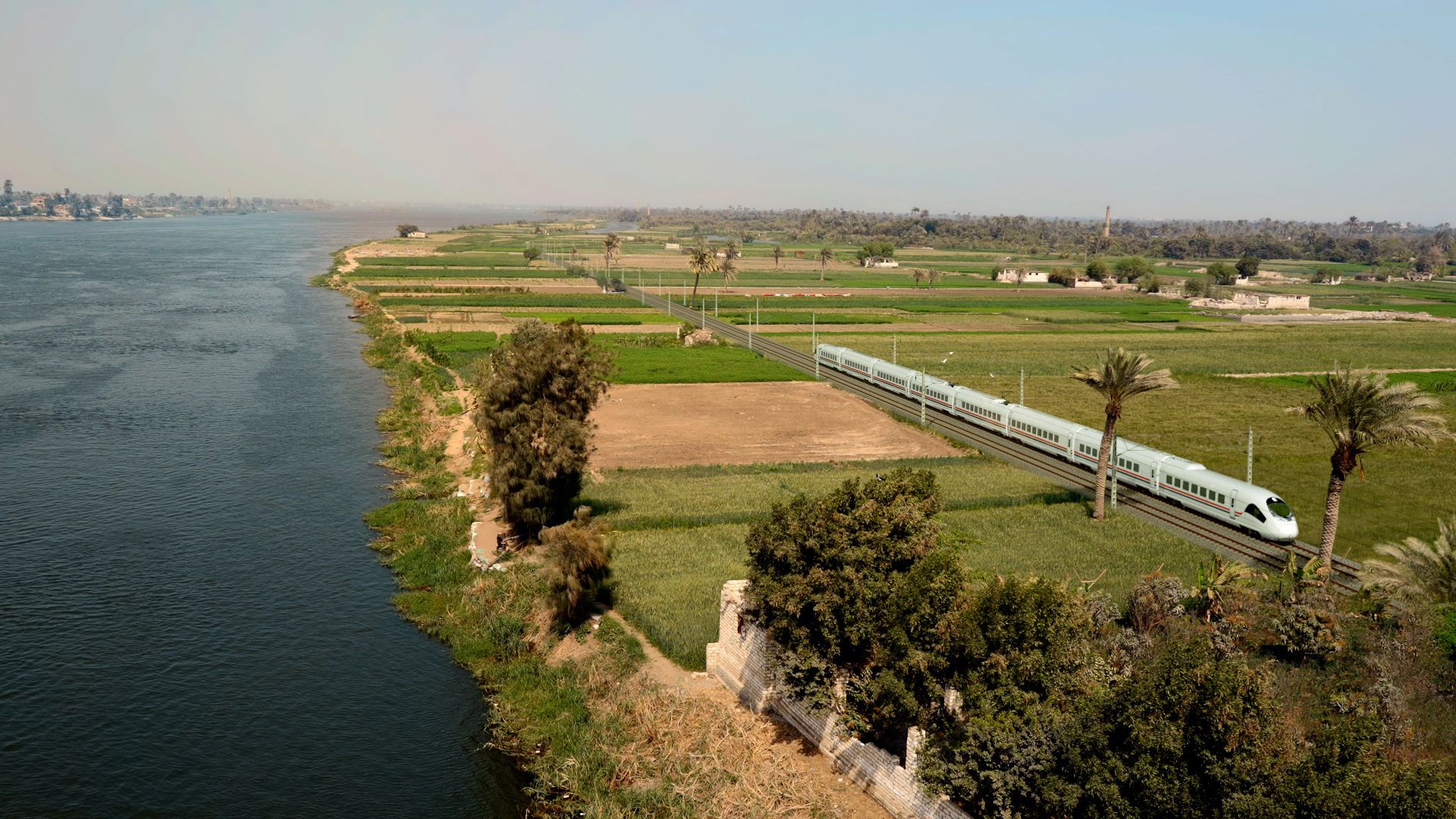
Connecting all of Egypt’s cities and tourist areas is the ambition of the Electric Express Train (EET) high-speed rail network. Since 2021, SYSTRA has been involved in this huge project as project management consultant, overseeing the construction of the network’s three lines, which are among the most ambitious high-speed rail projects in the world.
Electric Express Train: A comprehensive network of three high-speed lines
From the Mediterranean to the Red Sea and to Abu Simbel in the south, Egypt has the ambition to create a new high-speed lines covering the entire territory.
The EET network has multiple objectives: it aims to provide modern, fast, efficient, and safe transportation to stimulate tourism, modernise regional services, s, and improve freight transport throughout the country. This will improve connections between centres of activity and interconnect airports, port areas, logistics zones, and dry ports via a brand-new network.
Given its scale, with nearly 2,000km of new lines, its complexity, with 60 stations across the country, and the very tight deadlines imposed, the EET project is a huge challenge. The reward will be 1 million passengers expected on the Red and Blue lines, and 400,000 passengers on the Green line alone, which will be the first to be completed.
The Electric Express Train project in figures:
- 1,985km of new lines
- 60 stations
- Approximately 1.5 million passengers par day
- 3 lines:
- Green Line: 660km, 21 stations
- Blue Line: 1,100km, 36 stations
- Red Line: 225km, 3 stations
- 175 new trains:
- 41 high-speed trains (250km/h)
- 94 regional trains (160km/h)
- 41 locomotives (120km/h)

Green Line: from the Mediterranean to the Red Sea
From Ain Sokhna Port to Marsa Matrouh via the New Administrative Capital, October Gardens, and Alexandria, the EET network’s Green Line will account for one-third of the new line network. It will link 21 stations, including 10 high-speed stations and 11 regional stations, and will have one main depot and three auxiliary depots. Its route will require the construction of 25 bridges and engineering structures, with a total length of 49km.
- 660km
- 21 stations
- 25 bridges
In November 2021, SYSTRA signed a contract with the National Authority for Tunnels (NAT), a longstanding client of SYSTRA since 1970) to become Employer’s Representative, a role similar to that of Project Management Assistant, for the Green Line. SYSTRA’s mission is to supervise all construction sites with a view to integrating, supervising, coordinating, monitoring, and facilitating the execution of the project. We are relying on our longstanding local partners Arab Consulting Engineers (ACE) and Shaker Consultancy Group for this project.
SYSTRA is involved in project management, contract management, design review, general coordination and interface management, site supervision, implementation of backers’ environmental and social requirements, testing and commissioning, overall integration and operational support. Launch of the dynamic tests of the Green Line is expected to start in 2026.
Blue Line: backbone from north to south
From October Gardens near Cairo to Abu Simbel via Luxor and Aswan, the Blue Line runs along the Nile and crosses Egypt from north to south. Its total length exceeds 1,000km, requiring the construction of 13km of bridges and overhead structures, as well as 36 new stations, 10 dedicated to high-speed rail and 26 regional service stations.
Since the end of 2023, SYSTRA has been leading a consortium of project management consultants (PMCs) to supervise the construction of the Blue Line, alongside Egis.
- 1,100km
- 36 stations
- 13km of elevated structures
Red Line: connecting the heart of Egypt to the Red Sea
In addition to the Blue Line, the PMC contract won by SYSTRA as part of a consortium in 2023 also includes construction supervision for the Red Line, a 225km line between Qena, connecting with the Blue Line, and Hurghada and Safaga Port on the Red Sea. Three stations are planned, two dedicated to high-speed rail and one regional station. One of the main challenges for the project is crossing mountainous terrain, which will require the construction of tunnels and viaducts.
- 225km
- 2 high-speed stations
- 1 regional station
For the Blue Line and Red Line, the main challenge is to manage the entire project, from evaluating bids to project management, including reviewing studies, site supervision, particularly for railway systems and components, manufacturing supervision, testing and commissioning of rolling stock, as well as verification of the design of structures, architecture and electromechanical works for all stations and depots.
A high-speed network at the cutting edge of modernity and sustainability
The Electric Express Train high-speed network will, as its name suggests, be fully electrified, representing a major step forward in the transition of Egyptian transport towards greater sustainability. The rolling stock, built by Siemens, will be of three types:
- High-speed trains, with a maximum speed of 250km/h
- Regional trains at two levels, limited to 160km/h
- And locomotives, limited to 120km/h.
All lines will be equipped with ERTMS Level 2 signalling to enable interoperability of different rolling stock on the same tracks.
The EET network will be a reliable, safe, and sustainable mode of transport for Egyptians, tourists, and freight transport throughout the country. It will create thousands of jobs, support economic growth, and improve the daily lives of the local population.