The project brought together 4 women and 6 men, SYSTRA employees, from Brazil, India, Canada, France, Poland, the United Kingdom, and Dubai. Their assignment? To build the Rusumo bridge in northern Rwanda. This is the second project carried out by the SYSTRA Group with the NGO Bridges to Prosperity in Rwanda, following the construction of the Shyagari bridge in 2022.
In this remote region, half an hour’s walk from the main road, the dirt tracks are particularly dangerous during the rainy season, particularly because of the Nyirakibuye river, which floods whenever there is heavy rainfall. The construction of a bridge across the river has made it possible to provide children with safe access to two schools, tea plantation farmers with safe access to the two local markets, and pregnant women with safe access to the local maternity clinic. It has also brought the districts of Rulindo and Gicumbi, which are separated by the river, closer together.

This is a new assignment of solidarity fulfilled by the teams of the SYSTRA Group, with the support of Business Lines & Production, whom I would like to thank for their commitment. The Bridges to Prosperity initiative is an emblematic example of what SYSTRA can do to make a difference to provide safe and sustainable solutions to isolated populations in order to change their daily lives. It’s a project that conveys values and meaning and that makes us proud.
Christelle Chichignoud, Group Sustainability Director, SYSTRA
The SYSTRA team brought together people from all walks of life, engineers, and support staff, of all ages and of seven different nationalities. Around twenty Rwandan workers from Bridges to Prosperity, under the direction of project manager Jean-Pierre Hategekimana, took part in all phases of the project with our colleagues: pulling the suspension cables, assembling the prefabricated deck elements, launching and fixing the metal decking, filling and concreting the support pits, and painting and installing the cladding.
Despite the difficult weather conditions, the bridge was inaugurated on schedule, within the exact dimensions envisaged in the plans, and without any major incident during construction.
The assignment in a few figures:
A project which serves:
A new concrete colossus towers over the Grand-Rivière-Nord-Ouest valley on the outskirts of Port-Louis, the capital of Mauritius. This bridge, the only one of its kind in this part of the Indian Ocean, is the ‘SAJ’ bridge on the A1-M1 motorway designed by SYSTRA IBT. It links the communities of Sorèze and Coromandel to ease the flow of road traffic between the centre and west of the country, and to strengthen exchanges between the capital and its outskirts.
Our teams carried out all the studies, from detailed structural design to testing, including drainage studies, construction plans, and lightning protection.


We are delighted that the bridge has been officially inaugurated by the Mauritian authorities. This is the culmination of five years’ work by our design teams, and almost a decade’s work by the project teams, since the preliminary studies phase. At the beginning of February, we successfully concluded the final stage of the project with the bridge loading tests. I would like to extend my warmest thanks to everyone who has contributed to this extraordinary project.
Sanad Shamsan, Project Director, SYSTRA IBT
Visually, the architecture of this 330-metre bridge has been designed to make it one of the country’s most emblematic structures. And technically, the choice of an extradosed bridge supported by cable-stays ensures optimum structural stability and balanced load distribution.
The main technical challenge was the construction of the deck, consisting of a single box girder. Cast in situ balanced cantilever method, this deck is made with asymmetrical spans and constructed using additional temporary stays, designed to support the extra length of the side spans. With just 2 pylons, the bridge links the two cliffs while minimising its impact on the environment.
Given its geographical location, the A1-M1 bridge will also have to withstand the local wind climate. A detailed wind climate study of the project site was therefore carried out to investigate the impact of cyclones, both during construction and in service, and to derive the wind buffeting loads for the bridge design.
*The name Sir Anerood Jugnauth is that of an ex-prime minister and president of the Republic of Mauritius.
The Waaban Crossing Bridge awarded in CanadaThe latest accolade is the Project of the Year award from the Ontario Chapter of the American Concrete Institute (ACI Ontario Chapter)! This is major recognition from the profession for the reinforced concrete construction of this bridge, the design and construction of which was entirely supervised by SYSTRA IBT with Hatch and Kiewit as part of an IPD (Integrated Project Delivery) alliance contract with the town of Kingtson.
Our teams were involved in the execution studies, in particular for the design of the arch span and the prefabricated concrete beams, and then in the review of the studies and monitoring of the works.
The award was presented to SYSTRA at a ceremony held on 16 December 2023. The ACI had already awarded SYSTRA the Special Prize for the design of the Sheikh Jaber Al-Ahmad Al-Sabah causeway bridge in Kuwait.
This new ACI award comes on top of many others in the space of two years:

Copyright: City of Kington, Aeronsapper
The Waaban Crossing Bridge is also particularly innovative because of the way it takes the environment into account. In addition to the modal shift and the desaturation of road traffic, its overall water footprint has been reduced by more than 50% compared with the initial environmental assessment. The integration of the bridge into the landscape of the Rideau Canal, a UNESCO World Heritage site, was the result of close dialogue between local and heritage stakeholders.
The navigability of the canal was preserved without delaying the worksite, while the durability of the structure delivered exceeds the legal requirements for the design of a bridge of this type: designed to last 75 years, the Waaban Bridge was designed for a final life of 100 years. The 1.2 km-long bridge crosses the Cataraqui River to provide a better link between the east and west of Kingston, improve traffic flow from one bank to the other, and encourage active modes of transport with a multi-use path dedicated to walking and cycling.
SYSTRA International Bridge Technologies is excited to present our key speakers: Christopher Hall presenting a case study of the Davenport Diamond Project, Benjamin Soule giving an update on the Chicago CTA Red-Purple Modernization (RPM) Project, and Greg Glass discussing the Mosquito Road Bridge Replacement Project. These presentations are sure to be informative and engaging, offering insights into these significant pieces of infrastructure. Don’t miss this opportunity, and we look forward to seeing you there!

Since November 2022, our teams have been an integral part of the consortium in charge of designing the section between Merced and Madera (known as the M-M section) on the future high-speed line (HSL) in California, in the Central Valley area. We are responsible for carrying out the design studies for the route of the line (package NTP-1*), with the option of delivering the final design studies and preparing the documents to launch construction (package NTP-2).
Our work with the California high-speed rail program began in 2006 when we prepared a multi-decade implementation plan for the high-speed rail line. Subsequently, SYSTRA was a member of the program management team, supporting project delivery and implementation, strategy development, and regional coordination. Next, SYSTRA was a member of the team providing design for Construction Package 1 (CP1) – the initial operating section of the high-speed rail project and provided guideway embankment and structural design and construction support.

The final client for the project is the California High-Speed Rail Authority (CAHSRA), which has been overseeing this ambitious program since 1994.

The teams at SYSTRA USA are enthusiastic about the idea of bringing high-speed rail to California. We have been involved in this program since its inception, serving future users. By studying the possibilities of reducing the costs of the project, minimising risks, and improving journey times, SYSTRA is committed to supporting the creation of a network which is accessible, economical, and sustainable.
Frédéric Bana, Chief Operating Officer, SYSTRA USA
With its recognised expertise in half of the high-speed lines studied worldwide, SYSTRA is responsible for risk and configuration management, system integration, the design of all subsystems (power supply, train control, systems safety), as well as the structural and seismic parts of the preliminary studies to define the project’s footprint.
The purpose of these assignments is to advance the construction of the HSR line between Merced and Madera, as an extension of the portion already under construction in the Central Valley.

Since 2012, SYSTRA USA has supported FRA oversight of two higher-speed rail corridors in the Midwest. We have also studied the creation of high-speed rail networks in Texas and Florida and have been involved in multiple projects along the Northeast Corridor, the busiest passenger rail line in the US and the fastest one in operation today.
NTP: Notice to Proceed. An administrative document which, once added to the file, enables the works to begin.
New award for the Samuel-De Champlain Bridge
The International Road Federation (IRF Global*), gave this bridge the Achievement Award in the Quality Management category.
This prize, one of the most prestigious attributed in the roads sector, rewards the excellence of the bridge’s design, and especially the implementation of a quality management system throughout the design and construction phases.
The prize was given to the Design Joint Venture of engineering firms who designed the bridge: SNC-Lavalin, T.Y. Lin International and SYSTRA International Bridge Technologies.
Built to last 125 years, the Samuel-De Champlain Bridge was designed for multimodality with four road lanes, two dedicated to buses and bicycles, but also a dedicated rail track and pedestrian pathways.
This longevity is guaranteed thanks to the technical solutions employed to withstand all weather conditions:


Designed, built and completed in just 48 months, thanks to the massive use of high-performance steel and concrete elements, the Samuel-De Champlain Bridge welcomes some 50 million cars, buses and trucks every year, making it one of the busiest bridges in North America, almost three years after its inauguration.
It is one of the widest bridges in the world, with a total deck length of 50 metres, linking Montreal to Brossard, crossing the St. Lawrence River over a length of 3.4km. The latest news is the arrival of the metro on its central deck arrivée du métro sur son tablier central: the automatic REM du Sud line links will link Brossard to Montreal’s Central Station by crossing the bridge in spring 2023.
*IRF Global: an NGO founded in 1948 in Washington with the aim of promoting the development of road networks.
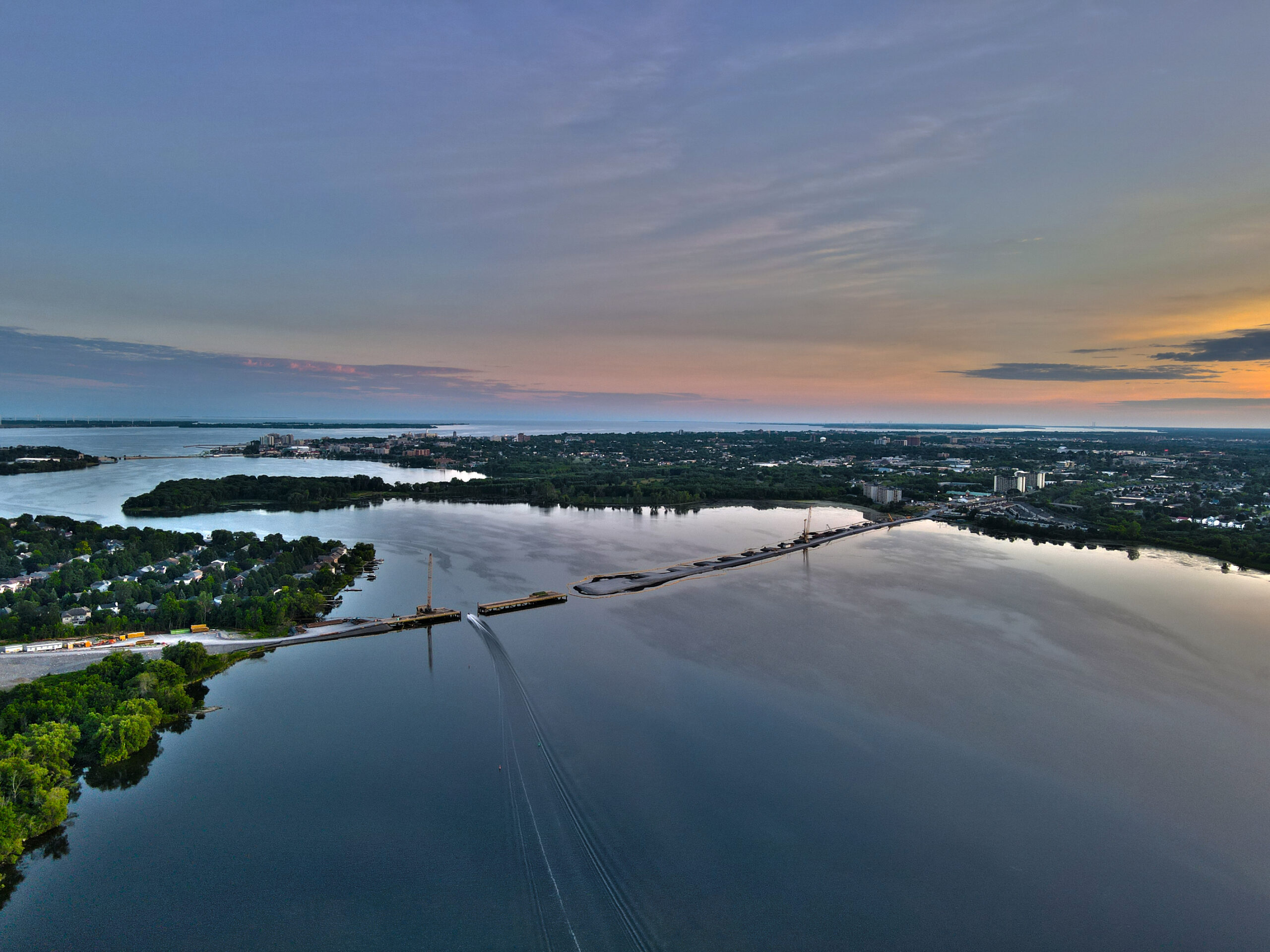
Inauguration of the Waaban Bridge in Kingston, CanadaThe Kingston Third Crossing project is over: the Waaban Crossing Bridge is here! This new Ojibwe language name*, which evokes the dawn and the morning light in the east, was chosen after a survey of local residents. Inhabitants had to opportunity to cross this structure on foot in the preview event on 24 September 2022. As of today the bridge is now open, for both vehicles and soft modes, which benefit from separate lanes. The Waaban Bridge connects the east and west sides of Kingston, separated by the Cataraqui River, which flows nearby into Lake Ontario and forms part of the Rideau Canal, a UNESCO World Heritage Site.
This third bridge over the Cataraqui River is intended to relieve traffic congestion and facilitate the movement of emergency vehicles from one side of the river to the other, while also contributing to the development of active transportation.
*Ojibwe: Algonquian language spoken in the Great Lakes region. It is one of the most widely spoken Amerindian languages.

This third bridge over the Cataraqui River is intended to relieve traffic congestion and facilitate the movement of emergency vehicles from one side of the river to the other, while also contributing to the development of active transportation.

We are proud to have been involved in the design and construction of this major bridge for the people of Kingston and the Lake Ontario region. Over the past five years, we have worked with our partners the City of Kingston, Kiewit and Hatch to ensure that this bridge meets the ambitions of our client and the community.
Zac McGain, project director, SYSTRA IBT
This bridge will make a difference to the lives of residents and will bring Kingston’s two shores closer together. I would like to thank all the teams who have been involved in making this project, the first to be carried out entirely by SYSTRA IBT, a great success!
Edouard Renneville, project manager, SYSTRA IBT

This inauguration is the culmination of a construction project that began five years ago and was launched in 2017, just a few months after International Bridges Technologies became part of the SYSTRA Group. One of the particularities of the project is its contractual form: SYSTRA IBT, the engineering firm Hatch and the construction company Kiewit formed an IPD (Integrated Project Delivery) contract with the City of Kingston, an integrated grouping that is a first in North America for linear infrastructure. One challenge is that it is the largest transportation project ever funded in Kingston’s history.
The benefits of this project are also environmental: in addition to the modal shift and the decongestion of road traffic, it has an overall footprint in water that is more than 50% smaller than the initial environmental assessment. Its visual impact on the Rideau Canal UNESCO site has also been reduced, thanks to close dialogue with local stakeholders and the heritage community. The IPD consortium implemented solutions to ensure the navigability of the Rideau Canal between spring and autumn without delaying the work, such as a mixed construction, with a temporary trestle bridge on one side and temporary rock fill on the other to allow for the foundations.
I-beams, known as ‘NU’ in reference to the University of Nebraska, which designed them, were used in the construction. They are prefabricated in pre-stressed concrete and offer greater resistance to flexion-torsion. Finally, it should be noted that the structure delivered to the Kingston authorities exceeds the legal requirements for the design of such a bridge: planned to last 75 years, the Waaban Bridge was designed for a final life of 100 years. This is a great achievement for a project that the authorities welcome as being delivered on time and on budget.
In California, the company Shimmick Construction laid the first stone of the new Mosquito Road Bridge, designed by SYSTRA IBT in partnership with Quincy Engineering Inc. Together, our teams carried out the preliminary studies and final design of this new structure which will overlook South Arm of the American River, for our client El Dorado County.

The construction of this new bridge resonates with the history of the United States: the American River is indeed the river where the gold rush began in 1848, with the discovery of the first nuggets at Sutter’s mill.
In the midst of gold fever, California acquired its first single-lane wooden bridge in 1867, replaced identically in 1939. This local landmark is however in poor condition: often under maintenance, nicknamed “Swinging Bridge”, it is known to be a dangerous traffic axis in the region, with a maximum weight limit per vehicle of 5 tons.

El Dorado County had therefore chosen SYSTRA to design a new structure, while retaining the historic wooden bridge, which will be limited to pedestrian and cyclist crossings. The Mosquito Road Bridge deck will culminate at 114 meters in height, and the maximum span between its piers will be 163.4m.
The structure chosen is that of a cantilever bridge, which will be made of a post-tensioned concrete box-girder with elements cast on site. SYSTRA IBT was more specifically responsible for the calculations for the preliminary studies, the final design of the superstructure and the columns, and the review of the studies for the foundations and the abutments.
When completed, by 2025, the Mosquito Road Bridge will provide a fast and direct connection for the surrounding communities to Sacramento and Lake Tahoe, through the California hinterland, via the town of Placerville in the Swansboro area.
On July 19, 2022, the John A. Roebling Medal was awarded to Daniel Tassin at the International Bridge Conference in Pittsburgh, Pennsylvania. Awarded once a year, this medal is one of the highest distinctions given to engineers for their exceptional contribution to technological progress in bridge engineering. This honour recognises Daniel Tassin’s entire career, more than 50 years of commitment to engineering and the infrastructure projects he has led, particularly in North America.
After graduating from the École Spéciale des Travaux Publics in Paris in 1971, and receiving a diploma from the CHEBAP section (specialising in reinforced and prestressed concrete) of the Centre des Hautes Études de la Construction, Daniel Tassin worked for 25 years alongside Jean Muller, one of the most illustrious bridge engineers and inventor of the prefabricated voussoir construction method. Together, they have participated in a large number of bridge projects around the world, including the Sunshine Skyway Bridge in Tampa, Florida, for which Daniel Tassin was the chief engineer.
In 2000, Daniel Tassin co-founded International Bridge Technologies (IBT), which joined the SYSTRA Group in 2017. Many signature bridges have been built since then: the Atlantic Bridge in Panama, the Puente de la Unidad in Mexico, the Pitt River and Port Mann bridges in Vancouver, Canada, the Sound Transit Central Link Light Rail in Seattle, the Abraham Lincoln and Lewis and Clark bridges in Louisville, the Second Vivekananda Bridge in India, and the construction of the Montreal Metropolitan Express Network in Canada.
Daniel Tassin is also the recipient of the American Segmental Bridge Institute (ASBI) Leadership Award and the lead author of the ASBI reference document, Design and Construction of Concrete Cable-Stayed Bridges. In 2018, he was elected to the U.S. National Academy of Engineering, an honor bestowed on the world’s most recognized engineers. Still active in the Group, he serves as SYSTRA IBT’s Senior Technical Advisor.

I am proud and honoured to have received this prestigious award, which rewards years of teamwork on projects that stand out for their technical rigour, optimisation of construction costs, respect for execution methods and the search for aesthetic quality, all at the service of the population.
Daniel Tassin, SYSTRA’s Senior Technical Advisor
The John A. Roebling Medal was created in honour of engineer and bridge designer John Augustus Roebling (1806 – 1869), inventor of twisted wire ropes, a technique essential to the construction of suspension bridges and still used today. He is best known for designing the Brooklyn Bridge, a true symbol of New York.
The Samuel De Champlain Bridge in Canada opens to train trafficOn 27 July 2022, the Samuel De Champlain Bridge was opened to rail traffic for the first time. SYSTRA IBT participated in the construction of the Bridge in partnership with T.Y. Lin International and SNC Lavalin. Our IBT and SYSTRA Canada teams are currently working on the certification of the bridge’s tracks, in partnership with T.Y. Lin.
Inaugurated in the summer of 2019, the Samuel De Champlain Bridge links the cities of Brossard and Montreal, replacing a previous structure that had become obsolete. It is above all a multimodal crossing and a feat of engineering with its three decks: two decks for road traffic (with eight lanes, including three for vehicles and one reserved to buses in each direction, as well as a multifunctional path for pedestrians and cyclists), and a central deck dedicated to the REM.

The Samuel De Champlain Bridge is one of the widest bridges in the world, with a total deck width of 50 metres. Its concrete and steel design has already won several awards, including the Precast/Prestressed Concrete Institute (PCI) International Transportation Structure Award.

On the same axis as the Bridge, and to propose a credible modal shift offer, the REM South will link Brossard (via the Rive-Sud station) to Central Station, crossing the St. Lawrence River. It will be operated with automatic driverless metro trains, which should be put into service on 1 December.



