This is a project of major significance, given that the bridge will be the second longest in the country and the longest sea-crossing cable-stayed bridge in Latin America.
Our Brazilian teams will work in close collaboration with SYSTRA IBT in the US and SYSTRA Korea to meet the requirements established in the context of a public-private partnership (PPP) between the State of Bahia and a Chinese consortium.
As part of its PMC tasks, the SYSTRA / Maia Melo consortium will carry out:

The management of this iconic project will enable us to consolidate our presence in the State of Bahia. In 2019, we won a huge contract for the evaluation of the bus rapid transit (BRT) in the city of Salvador.
Marc-Olivier Maillefaud, CEO of SYSTRA Brazil
Itaparica bridge figures among the many projects being financed in the context of China’s Belt and Road Initiative.
At the end of 2020, a public-private partnership (PPP) contract was signed between the State of Bahia and a Chinese consortium formed by China Railway 20th Bureau Group Corp (CR20G) and China Communications Construction Company (CCCC) for the design, construction, operation, and maintenance of the bridge.
The PPP contract is for 35 years, including 5 years for the design and construction. The scope includes the bridge itself and the access points: a tunnel on the Salvador side, a road network on Itaparica island.
This new bridge, with a total length of 12.4km, is key to the development of Bahia as vehicles will no longer have to go around the Bay of All Saints, the principal bay in the state.
It greatly reduces the distance between the state capital Salvador and the south of the state by nearly an hour’s drive and will play an important role in creating wealth in northeast Brazil.
SYSTRA wins the new Grenland Bridge projectThe assignment of our DJV will be to carry out the detailed design of the New Grenland Bridge at the entrance to the Frierfjord in south-east Norway. It will double the existing Grenland Bridge, which has a 10-metre wide deck accommodating 2 traffic lanes and cannot be widened.
The decision to build this new bridge was taken to enable the E18 motorway, linking the towns of Langangren and Rugtvedt, to be converted into a 2×2 lane motorway on this section. SYSTRA will work on the project with the Norwegian engineering firm Afry, the engineering and construction firm Bertelsen & Garpestad AS, as well as with the bridges and viaducts expert Michel Virlogeux.
This new engineering structure will be a cable-stayed bridge with a single H-shaped pylon and a deck with a total length exceeding 600 metres and a height of 166 metres at the top of the pylon. The main span of 330 metres will be constructed in prefabricated 21-metre long segments brought by barge and raised to the deck level with lifting equipment.
Erica CALATOZZO, Head of Civil and Elevated Engineering Studies
Our participation in the design of the New Grenland Bridge forms part of our development strategy in Norway. We have already been involved, in partnership with Mott MacDonald and COWI on behalf of Vinci, NCC and Weiss und Freitag, in another important project for the country: the Follo railway line, which includes the longest tunnel in the whole of Scandinavia.
From 2013 to 2015, our consortium developed an integrated design for a D&B contract, with SYSTRA working on systems integration.
Construction of this tunnel is scheduled for completion in 2022. One of the objectives of the Norwegian authorities is for the New Grenland Brige to accommodate freight traffic, particularly from trucks on the E18 motorway.
• Direct client: Eiffage Génie Civil
• Final client: Nye Veier
• Road with 2 lanes
• Total length of the bridge: 604m
• Guyed span: 330m
• 1 single pylon of 166m
• Commissioning: summer 2025
This honor is testimony to his leadership in concrete segmental bridge design and construction, in a career spanning nearly five decades.
You worked with the late Jean Muller, the famous French bridge designer—what did you learn from this experience?
Jean Muller was an engineer as well as an architect, builder, and inventor. This is a rare combination of talents in a single person, which cannot be found nowadays. He taught me that good designs must not only be structurally sound but also economical and buildable with an aesthetic appeal. In his opinion, the ability to work hard and intellectual honesty are the two fundamental qualities an engineer must possess.
How has the engineering sector changed over the course of your career?
A lot has happened in 45 years… When I started working as an engineer, we used slide rules for our calculations and mail, telex, and the telephone for communications. We know how much all this has changed with modern computers and the internet. We used to have 5cm-thick design codes. They have now grown to five times this size. The design process has become more complex with sometimes two independent reviews, ISO quality-control procedures, and additional levels of management.
These are all major evolutions, but we have to be careful to avoid losing creativity as a result of only following strict guidelines. We also must not blindly accept the results given to us by computers but use our engineering judgment.
As a designer, what structures have inspired you in your work?
When I was at engineering school, I remember visiting the Brotonne Bridge in Normandy during its construction. At the time, this 320m span was the longest in the world for a cable-stayed concrete box girder. This breakthrough design was at the same time a strikingly elegant structure. It served as a model for the Sunshine Skyway Bridge in Florida, which was built 10 years later.
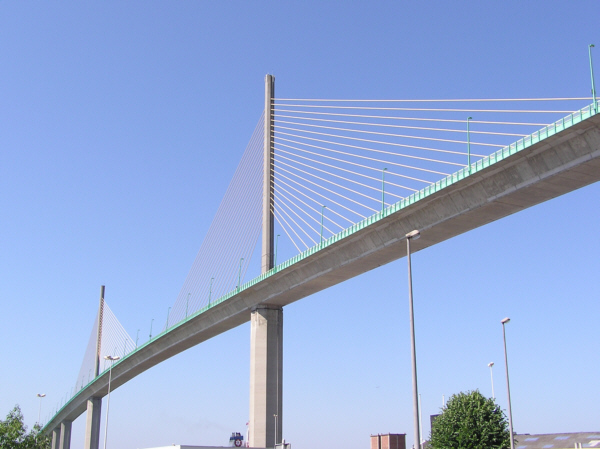
I have always been very impressed by the Normandy Bridge in France. It was also a breakthrough at the time of its construction: the 856 m main span was a giant step compared to other cable-stayed bridges of its era.
Similarly, the Burj Khalifa tower in Dubai is a beautiful structure resembling a spear aimed at the sky. It was a giant step technically, with a height of 828m compared to 452m for the world’s tallest building at the time.
What has been the greatest challenge of your career?
After working for five years in a design office in Paris, I took an assignment to participate in the construction supervision of the Florida Keys bridges south of Miami. Jean Muller’s design for these bridges over water was totally new, especially in the USA, where precast segmental construction was unknown.
With my poor command of the English language and relative lack of bridge construction knowledge, this was a real adventure. But, in the end, it was a unique experience.
What achievement are you most proud of?
Probably the Confederation Bridge in Canada. This was a giant structure with 44m x 250m spans in deep water across the Northumberland Strait and ice forces as high as 3,000t acting on each pier. The bridge was totally precast, including the foundations, and the largest superstructure pieces weighed as much as 7,500t. The structure was assembled using a giant crane, the Svanen, in 12 working months, a record for a bridge of this size.
The schedule was so tight that we sometimes produced construction drawings before the design was completed. Some of the foundation elements were put in the water before the design was approved. Nobody would take such risks nowadays.
What advice would you give to engineers starting out in their career?
Spending time in school gives us the tools for designing bridges, but we really become engineers by learning how to use these tools. The key is to go through as many projects as possible from design to end of construction and learn from our mistakes, as well as others’ mistakes.
We should remember that bridges are very visible structures in the environment, and they last for many years. This is why we should pay attention to the visual aspects of our designs.
How will bridge engineering change in the foreseeable future?
The strength of materials like steel and concrete has increased steadily over the past years. This trend will probably continue. Composite materials have not yet been widely used in bridges because of cost issues. However, they offer excellent solutions for repairing existing bridges.
The infrastructure is aging, at least in North America, and there will be an increasing demand for bridge rehabilitation or replacement. As an example, we recently replaced all the stay cables of a bridge in Louisiana under traffic.
Building Information Modeling (BIM) is revolutionizing the way engineers and contractors communicate. This will probably become applicable to bridge design too.
After a thorough Request for Proposals (RFP) and evaluation phase, the City of Kingston in Ontario, Canada, has selected SYSTRA International Bridge Technologies (SYSTRA), Peter Kiewit Sons ULC (Kiewit) and Hatch Ltd (Hatch) as the preferred proponent for the detailed design and building of the Third Crossing project.
SYSTRA, Kiewit and Hatch were one of three shortlisted proponents to submit a proposal on the bridge project. Seven international teams initially applied for the job when requests for proposals were issued in February 2018.
To deliver this project on time and on budget the City has chosen an Integrated Project Delivery model (IPD). This model is similar to a design-build model with the exception that the City of Kingston, along with the contracted design and construction partners, will work within the defined $180m budget and share the risk and reward to deliver the best possible bridge. The four teams develop shared goals and accept responsibilities as equal partners.
From September 2018 through to December 2019 the new project team will be doing early site preparation, conducting additional environmental and geotechnical investigations to inform the work with Parks Canada, and working through design validation. Construction of the bridge is expected to begin in summer 2019. The project is being jointly funded by the Government of Canada, the Province of Ontario and the City of Kingston.
Once complete, the new 1.2km bridge will extend over the Cataraqui River connecting the east side and west side communities. A new two-lane bridge will improve emergency services response, increase active transportation through a multi-use pedestrian and bike pathway, create business connections on the east and west sides of the river, and enhance the life of residents and visitors of Kingston while meeting the highest engineering standards.
The new project team is looking forward to connecting with residents and hearing ideas about integrating the new bridge into the Kingston community. Communication and engagement programmes will be part of the bridge’s detailed design and construction phases later in 2018 and into 2019. The team has also launched a City of Kingston Get Involved page and encourages residents to ask questions.
Mark Gerretsen, Member of Parliament for Kingston and the Islands, on behalf of the Honourable François-Philippe Champagne, Minister of Infrastructure and Communities
“Infrastructure projects like the Third Crossing bridge in Kingston connect people, support job creation and boost economic development opportunities. This is why the Government of Canada is providing unprecedented funding and support for public infrastructure projects that help grow the middle class and promote the long-term prosperity of communities across the country.”
Monte McNaughton, Minister of Infrastructure
“Providing funding for the right infrastructure projects at the right time has a positive impact on people and communities across the entire province. Our decision to invest in the Kingston Third Crossing Bridge project will help bring economic benefits, create great paying jobs for our people and make Ontario competitive again.”
Bryan Paterson, Mayor of City of Kingston
“Today is another significant step in moving this project forward. This is the largest infrastructure project our city will undertake for years to come, employing hundreds of people over several years. I am just thrilled and excited to get construction started.”
Mark Van Buren, deputy commissioner and project director
“After a comprehensive and competitive procurement process, we’re happy that SYSTRA, Kiewit and Hatch are joining the Third Crossing project. We started this process with seven exceptional international firms interested in coming to Kingston to work on this job and today we’ve selected the top proponent team. Having this collaborative team will ensure we build the best bridge possible for all residents while helping meet our long-term transportation goals.”
Zachary McGain, Canadian general manager for SYSTRA IBT
“This is an important community project that will make a positive impact on the lives of Kingston residents. As an international company with a strong track record in bridge design, we are proud to be part of the team delivering North America’s first IPD bridge. Together, we will blend technical innovation and aesthetic design to deliver the best value for the City of Kingston.”
Mark Mallett, project director, Kiewit Sons ULC
“We are thrilled to be working with the City of Kingston on this very important community project. We’ve been following the evolution of this project for several years wanting to ultimately be the final team standing here today. We’re excited to be working on the Third Crossing project, the first IPD bridge in North America and ready to get to work.”
Philip Murray, global director, EPC and AFP, Hatch Ltd
“Hatch is delighted to be involved in the largest ever infrastructure undertaking by the City of Kingston. We are looking forward to providing the very best of Hatch for this opportunity and hope to create something truly representative of this community.”


